
How Digital Lending Platforms Really Assess Borrower Creditworthiness
Digital lending has moved credit decisions from branch offices and paper files to smartphones, APIs, and machine learning models. Yet at its core, the question is unchanged: can this borrower reasonably be expected to repay?
What has changed is how that question is answered. Online lenders, neobanks, buy-now-pay-later (BNPL) providers, and embedded finance platforms now combine traditional credit data with alternative signals, real-time analytics, and automated decisioning. This article unpacks how those systems work, what data they use, why regulators are watching closely, and what it means for consumers, investors, and the broader financial system.
From scorecards to algorithms: the evolution of credit assessment
For most of the 20th century, banks relied on human underwriters and simple scorecards built around the "5 Cs of credit" (character, capacity, capital, collateral, and conditions). The rise of centralized credit bureaus and standardized scores such as FICO in the United States and Experian, Equifax, and TransUnion scores in many markets shifted much of that judgment into statistical models based on past repayment behavior.
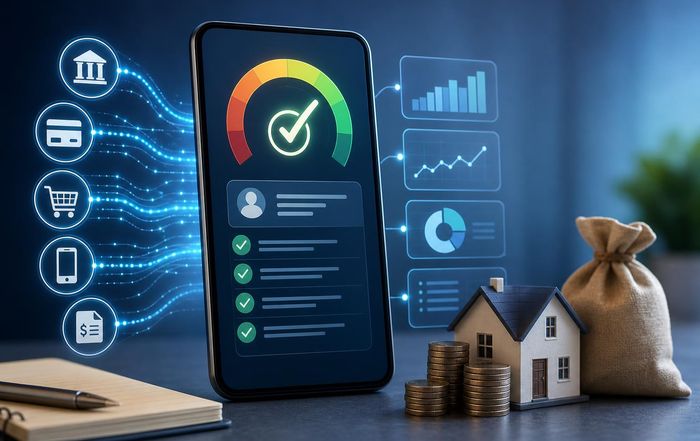
Digital lending platforms build on this foundation but extend it in three important ways. First, they source data from many more places than legacy lenders, including bank transaction feeds, payroll APIs, e-commerce histories, and sometimes device data. Second, they process this information in near real time, often giving decisions in seconds. Third, they frequently use more complex modeling techniques, including machine learning, to identify patterns that traditional scorecards might miss.
Regulators from the U.S. Consumer Financial Protection Bureau (CFPB) to the European Banking Authority (EBA) have emphasized that, despite new technology, lenders must still meet long-standing standards on responsible lending, fair treatment, and data protection. The technology may change, but the legal and prudential obligations do not.
Core data sources: what digital lenders look at first
Most digital lenders still start with the same basic building blocks as banks, especially for larger or longer-term loans. The difference is how they collect, verify, and combine the data.
A typical platform will request identity information, income details, and permission to access credit bureau data. In many markets, credit bureaus such as Experian and Equifax provide not only a score but also detailed tradeline information: open accounts, balances, payment histories, delinquencies, and public records such as bankruptcies where allowed. For consumers in the US, agencies like AnnualCreditReport.com (authorized by the Federal Trade Commission) are the official source for checking these files, which also helps borrowers understand what lenders see.
Income and employment are increasingly verified digitally. In the US, services like The Work Number and payroll APIs used by fintechs can confirm employment status and salary directly with employers or payroll providers. In Europe and the UK, open banking rules under PSD2 and the UK Open Banking framework allow consumers to share bank transaction histories with lenders via secure APIs, making it possible to infer income and spending patterns from account data rather than pay stubs alone. This is becoming a core part of affordability checks, especially for unsecured consumer loans and credit lines.
For platforms operating in small business or property lending, financial statements, tax filings, and cash-flow reports remain important. However, instead of uploading PDFs, many borrowers now connect their accounting software or bank accounts directly, enabling continuous monitoring of performance. That integration is increasingly relevant for lenders and investors interested in business and property finance trends.
Alternative and "non-traditional" data: expanding the picture
One of the most discussed features of digital lending is the use of "alternative data" to assess creditworthiness, especially for borrowers with thin or no traditional credit history. The World Bank and other organizations have highlighted that alternative data can help close credit gaps for small businesses and consumers in emerging markets, but it also raises significant privacy and fairness questions.
Common categories include:
Bank transaction data beyond standard income checks. Lenders analyze inflows and outflows to infer income stability, recurring obligations, discretionary versus non-discretionary spending, and early signs of distress (such as frequent overdrafts). This is a core use case for open banking data in markets like the UK and the EU, and is increasingly common in other regions.
Utility, telecom, and rent payment histories. In some countries, positive payment history on utilities and rent is being added to credit files or used separately to assess reliability. Experian Boost, for example, lets US consumers add certain utility and telecom payments to their Experian file, which some digital lenders may factor into decisions.
E-commerce and platform data. For merchants selling on marketplaces like Amazon, Shopify, or regional platforms, lenders may use sales histories, customer ratings, return rates, and inventory data to predict business performance. Several fintechs specialize in revenue-based financing where repayment is linked directly to future sales.
BNPL and short-term credit histories. As BNPL has grown, regulators such as the UK Financial Conduct Authority (FCA) have moved to bring these products within credit regulation. Many BNPL providers now report to credit bureaus or share internal histories, giving lenders a view of how applicants handle these obligations.
Device and behavioral data. Some lenders, particularly in mobile-first emerging markets, use device metadata (such as phone model, app usage patterns, or SIM tenure) and behavioral signals (how quickly forms are filled, typing patterns, or geolocation consistency) as part of fraud detection and, in some cases, credit risk models. The International Finance Corporation (IFC) and academic studies have examined how such data can predict default, but this is one of the most controversial practices from a privacy and ethics standpoint.
Regulators and organizations like the OECD and Bank for International Settlements (BIS) have cautioned that alternative data must be used carefully to avoid discriminatory outcomes, opaque decisioning, and over-collection of personal information. In many jurisdictions, data protection laws such as the EU's GDPR and similar frameworks elsewhere limit what can be collected and how long it can be retained, and require a clear legal basis and purpose limitation.
Credit scoring models: from logistic regression to machine learning
Once data is collected, the heart of digital credit assessment is the scoring model. Traditional lenders often use logistic regression or similarly interpretable statistical techniques to estimate the probability of default based on a set of variables (credit score, income, debt-to-income ratio, etc.). Many digital platforms still use these methods, especially where regulation or internal risk policy demands transparency.
However, some fintech lenders and large platforms have turned to more complex machine learning approaches, such as gradient boosting machines, random forests, or neural networks. These models can capture non-linear relationships and interactions among variables that are hard to specify in advance. Academic research published by institutions such as the National Bureau of Economic Research (NBER) and the Federal Reserve has found that, when carefully designed, machine learning models can improve predictive power and sometimes extend credit more accurately to underserved borrowers.
That said, regulators including the CFPB, FCA, and EBA have made clear that explainability and fairness remain essential. The CFPB's guidance on adverse action notices stresses that lenders using complex algorithms must still provide specific, understandable reasons for credit denials or unfavorable terms. This has led many digital lenders to adopt hybrid approaches: using machine learning to identify candidate variables and patterns, but then embedding them in more interpretable scorecards, or using model-agnostic explainability techniques to generate human-readable reasons.
For investors and market observers following developments in tech and banking, the tension between model performance and regulatory expectations is a key competitive and compliance factor for digital lenders.
Affordability, income verification, and debt-to-income checks
Creditworthiness is not only about the probability of default; it is also about whether a loan is affordable given a borrower's circumstances and regulatory standards. After the global financial crisis, many jurisdictions strengthened rules around affordability and responsible lending.
In the US, the CFPB's Ability-to-Repay rules for mortgages and its broader supervision of consumer credit require lenders to consider income, assets, obligations, and debt-to-income ratios. In the UK, the FCA has set out detailed expectations for affordability assessments across consumer credit products, including BNPL and high-cost short-term credit. The European Banking Authority has similar guidelines for EU lenders.
Digital platforms operationalize these requirements by:
Using bank transaction data to identify net income and recurring obligations (rent, utilities, existing loans, child support).
Calculating debt-to-income (DTI) or similar ratios automatically.
Applying policy rules (for example, maximum DTI thresholds or minimum residual income after debt service and living expenses).
Running scenario analyses for variable-rate loans or income volatility, especially for self-employed borrowers and gig workers.
Open banking has made these processes more granular. Instead of relying on self-reported income and a few pay slips, lenders can see months or years of transaction history. That can benefit borrowers with stable but non-traditional income patterns, such as freelancers or platform workers, who might otherwise appear riskier on a simple income statement. However, it also means that lenders can see more of a borrower's financial life, raising questions about data minimization and consumer understanding, which consumer advocates and regulators continue to debate.
These practices connect closely to topics we cover under finance and consumer finance, where household debt burdens and affordability standards are central themes.
Fraud detection and identity verification: separating risk from abuse
Credit risk and fraud risk are distinct but intertwined. A borrower who genuinely cannot repay is different from an identity thief who never intended to repay at all, but both can lead to losses. Digital lenders therefore invest heavily in know-your-customer (KYC), anti-money laundering (AML) checks, and fraud analytics as part of the credit assessment process.
Identity verification typically involves document checks (passports, national IDs, driver's licenses), address verification, and database checks against sanctions and politically exposed persons (PEP) lists, often guided by standards from bodies like the Financial Action Task Force (FATF). Many platforms use specialized providers for document verification and liveness checks to minimize synthetic and impersonation fraud.
On the analytics side, device fingerprints, IP addresses, login patterns, and application behavior are monitored for anomalies. For instance, multiple loan applications from different identities but the same device in a short time window may trigger enhanced checks. These fraud-screening signals are sometimes integrated into credit decisioning: an application flagged as high fraud risk may be declined or limited even if the underlying credit profile looks strong.
From a regulatory perspective, AML and KYC obligations sit alongside consumer protection and prudential rules. Institutions such as the Financial Stability Board (FSB) and national supervisors have warned that rapid, automated lending can amplify fraud losses if controls are weak, particularly in cross-border and digital-only environments.
Regulatory frameworks, fairness, and explainability
As digital credit models grow more complex, regulators have sharpened their focus on fairness, transparency, and systemic risk. Three themes stand out.
First, anti-discrimination and fair lending laws in jurisdictions such as the US, UK, EU, and many others prohibit credit decisions based on protected characteristics (such as race, gender, or religion) and, in some cases, on proxies that have similar effects. Research from the Federal Reserve, European Central Bank, and academic institutions has shown that complex models can inadvertently encode and amplify historical biases present in training data. Supervisors increasingly expect lenders to test models for disparate impact and to adjust features or policies where necessary.
Second, explainability has become a central concern. Under laws like the EU's GDPR and national consumer credit regulations, borrowers often have the right to understand key reasons for adverse decisions. The CFPB's recent guidance on algorithmic decision-making explicitly states that lenders cannot cite "trade secrets" or "complex algorithms" as a reason for not providing meaningful explanations. This has implications for how digital lenders design models and how they document and govern them internally.
Third, data protection and cybersecurity requirements shape what data can be used and how it must be handled. Supervisors such as the European Data Protection Board (EDPB) and national data protection authorities have scrutinized the use of behavioral and device data, particularly when it goes beyond what is strictly necessary for credit assessment and fraud prevention. Data breaches involving credit data-like the well-known Equifax breach-have underlined the systemic consequences of poor security in this domain.
For market participants tracking economy and world regulatory developments, these frameworks are increasingly central to the competitive landscape for digital lenders, as compliance costs and constraints can shape which business models are viable.
Embedded lending, BNPL, and real-time decisioning
One of the biggest shifts in recent years is embedded lending: credit offered directly within non-financial platforms, from e-commerce checkout pages to ride-hailing apps and B2B marketplaces. BNPL is the most visible consumer example, but similar models are emerging in small business procurement, SaaS subscriptions, and supply-chain finance.
In these contexts, credit decisioning must happen in seconds, often with minimal friction for the user. That pushes lenders to rely heavily on pre-existing data relationships and real-time scoring:
E-commerce BNPL providers may use shopping cart value, merchant type, past repayment history with the provider, and soft credit checks to approve or decline at checkout.
B2B embedded lenders may integrate directly with accounting or invoicing software to assess cash-flow and approve a working capital line within minutes.
Platform-based lenders may leverage data on ride volumes, delivery routes, or platform earnings to underwrite loans for gig workers and small merchants.
Regulators in markets like the UK, Australia, and the EU are tightening oversight of BNPL and similar products, requiring more robust affordability checks, clearer disclosures, and in some cases, integration with credit reporting systems. The UK FCA's work on BNPL regulation, the Australian Securities and Investments Commission (ASIC) oversight, and the European Commission's consumer credit directive reforms illustrate how quickly the regulatory perimeter is adapting to these models.
For investors and analysts following markets and investing, the success of embedded lending models hinges not only on user adoption but also on how well these real-time credit engines manage risk across economic cycles.
Implications for borrowers, lenders, and the financial system
For borrowers, digital credit assessment can mean faster access to funds, more tailored products, and, in some cases, inclusion for those previously excluded from formal credit. Thin-file borrowers, gig workers, and small online merchants may benefit when lenders use richer data and more nuanced models rather than blunt rules. However, these benefits come with trade-offs: more invasive data collection, potential algorithmic bias, and the risk of over-borrowing when friction is reduced and offers are embedded seamlessly into everyday apps.
For lenders and fintechs, sophisticated credit assessment is both a competitive advantage and a regulatory risk. Platforms that can accurately distinguish good risk from bad, especially in volatile conditions, can grow profitably and attract funding. Those that misprice risk or run afoul of fair lending or data protection rules may face losses, enforcement actions, and reputational damage. Supervisory authorities and bodies like the Basel Committee on Banking Supervision are increasingly focused on how digital credit models perform under stress and how they are governed.
At the system level, the spread of digital lending raises questions about credit cycles, consumer indebtedness, and financial stability. If many platforms rely on similar data sources and modeling techniques, there is a risk of correlated errors, especially in downturns or when data patterns change abruptly (as seen during the COVID-19 pandemic). Central banks, including the Bank for International Settlements and major national authorities, have called for better data and transparency on non-bank digital lenders to monitor systemic risk.
As regulators refine rules and technology continues to evolve, the way digital platforms assess creditworthiness will keep changing. What is unlikely to change is the central challenge: balancing speed, inclusion, and innovation with prudence, fairness, and respect for borrowers' rights.
