
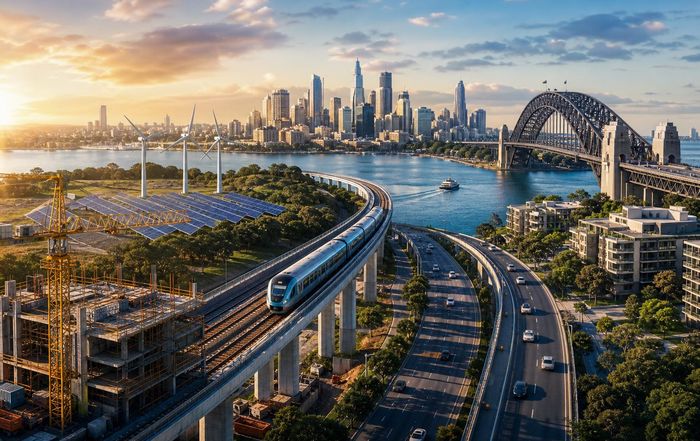
Australia's Infrastructure Investment: Where the Opportunities Are - and the Risks Investors Can't Ignore
Australia has become one of the most closely watched infrastructure markets in the world. A combination of strong population growth in key cities, a long pipeline of transport and energy projects, and a sophisticated regulatory environment has attracted global pension funds, sovereign wealth funds, private equity, and infrastructure specialists for more than two decades. Yet in recent years, higher interest rates, political scrutiny of privatizations, and cost blowouts on megaprojects have shifted the risk-reward balance.
For investors trying to understand whether Australian infrastructure still merits a place in a global portfolio, the essential question is no longer just "where is the growth?" but "under what conditions does the growth translate into acceptable risk-adjusted returns?" This new article examines the core opportunity set, the evolving risk landscape, and how different types of investors are positioning.
Why Australia Matters in Global Infrastructure Portfolios
Australia is often described as a "laboratory" for infrastructure investment and regulation. The country was one of the earliest and most active adopters of privatization and public-private partnerships (PPPs), particularly from the 1990s onward. According to Infrastructure Partnerships Australia, more than A$400 billion of infrastructure assets across transport, utilities, and social infrastructure have been delivered through private capital since the mid-1990s, creating a deep market for both greenfield and brownfield investments.
Several structural features underpin its appeal:
Australia has experienced sustained population growth concentrated in a handful of large metropolitan areas, notably Sydney, Melbourne, Brisbane and Perth. The Australian Bureau of Statistics (ABS) projects the national population to continue growing strongly over coming decades, which feeds long-term demand for transport, energy, water, telecommunications and social infrastructure. The country also enjoys relatively stable institutions, a strong rule of law, and an established regulatory framework across sectors such as electricity networks, gas pipelines, and airports. Bodies like the Australian Energy Regulator (AER) and the Australian Competition and Consumer Commission (ACCC) provide a degree of predictability around pricing and returns that many emerging markets lack.
At the same time, Australia's infrastructure deficit remains material. The 2021 Australian Infrastructure Plan from Infrastructure Australia identified large gaps in transport, digital connectivity, energy transition infrastructure, and resilience to climate risk. The federal government's rolling 10-year infrastructure investment pipeline (tracked by the Department of Infrastructure, Transport, Regional Development, Communications and the Arts) and state-level plans in New South Wales, Victoria, Queensland and Western Australia together outline hundreds of billions of dollars in planned or proposed projects.
For global investors looking for long-duration, inflation-linked cash flows, this combination of demand growth, institutional quality and investment need has historically been compelling. But conditions are changing.
The Core Opportunity Set: Transport, Energy, Digital and Social Assets
The opportunity in Australian infrastructure can broadly be divided into four buckets: transport, energy and utilities, digital infrastructure, and social/essential services. Each has distinct return drivers and risk profiles.
Transport infrastructure - including toll roads, airports, ports and rail - has long been a cornerstone of Australian infrastructure portfolios. Iconic assets such as Sydney Airport, Transurban's east-coast toll road networks, and major container ports have attracted intense interest from global investors. The 2022 takeover of Sydney Airport by a consortium led by IFM Investors and Global Infrastructure Partners for around A$23.6 billion, for example, was one of the largest infrastructure deals globally. These assets benefit from population and trade growth, and in many cases from regulated or concession-based revenue models, but they are also exposed to economic cycles, fuel prices, and shifts in travel patterns.
Energy and utilities are entering a new phase driven by decarbonization. Australia has committed to net-zero emissions by 2050, with interim targets including a 43% reduction in emissions from 2005 levels by 2030 at the federal level, and often more ambitious goals at the state level. The Australian Energy Market Operator (AEMO), in its Integrated System Plan, estimates that the National Electricity Market will need a massive build-out of renewable generation, storage and transmission to replace retiring coal plants. This creates opportunities in utility-scale solar and wind, battery storage, pumped hydro, hydrogen, and grid upgrades, alongside regulated network businesses. However, it also introduces new technology, policy and merchant power price risks that investors must price carefully.
Digital infrastructure has become a mainstream asset class in its own right. Data centres, fibre networks, submarine cables and mobile towers in Australia are drawing capital from global infrastructure and private equity funds, often via platform plays. The rollout of 5G networks, the ongoing evolution of the National Broadband Network (NBN), and demand from cloud providers and AI workloads underpin growth. Yet competition, regulatory scrutiny around data and foreign ownership, and rapid technology shifts can affect valuations and business models.
Social and essential services infrastructure - including hospitals, schools, prisons, social housing and government accommodation - is more niche but still important. Many of these assets have been developed under PPP models, with long-term availability-based payments from state governments. For investors seeking stable, lower-risk cash flows, these projects can be attractive, although returns are typically tighter and structures more complex. They also face political and reputational risks if service delivery becomes contentious.
For readers interested in how these sectors interact with broader capital markets, the infrastructure themes increasingly overlap with equity and bond markets, listed infrastructure funds and REITs, and private credit structures used to finance large projects.
The Energy Transition: Australia's Biggest Long-Term Theme
The energy transition is arguably the single most significant driver of new infrastructure investment in Australia over the next two to three decades. The pace and shape of this transition will strongly influence returns across power generation, networks, storage, industrial decarbonization and even transport.
Australia's current electricity mix still includes a large share of coal, but coal plants are retiring faster than originally scheduled. AEMO's latest Electricity Statement of Opportunities warns of reliability gaps if replacement renewable and firming capacity is not delivered on time. States such as New South Wales and Victoria have created Renewable Energy Zones (REZs) to coordinate transmission and generation investment, while the federal government has introduced policies such as the Capacity Investment Scheme to underwrite new clean energy and storage projects. These frameworks are intended to de-risk private investment by providing more predictable revenue structures, often via contracts-for-difference or capacity payments.
For investors, this opens several lines of opportunity. Utility-scale solar and onshore wind remain central, but margins are tightening in some regions due to grid congestion, curtailment risk and falling daytime wholesale prices. Battery storage - particularly grid-scale lithium-ion projects - is expanding rapidly, with additional interest in pumped hydro and emerging technologies. Transmission projects, often regulated with allowed returns set by the AER, can offer lower-risk, long-duration cash flows, though they face planning, community acceptance and delivery challenges.
Offshore wind, green hydrogen and related export infrastructure are more speculative but potentially significant themes. The federal government has declared several offshore wind zones, and feasibility licenses are being issued. Meanwhile, Australia's ambitions to become a major exporter of green hydrogen or hydrogen-derived fuels (such as ammonia) have attracted attention from international energy companies and trading houses. However, many of these projects remain in early stages, with uncertain economics and policy support, so investors are generally approaching them as higher-risk, development-heavy plays rather than core infrastructure.
The energy transition also intersects with sustainability and ESG-focused investing. Many institutional investors now have portfolio-level climate targets and are under pressure to demonstrate progress toward net zero. Australian infrastructure can help meet those goals, but only if projects are structured to manage transition risk, avoid stranded assets, and address social and environmental impacts on local communities and First Nations groups.
Transport and Urban Growth: Toll Roads, Airports and Rail
Australia's major cities are grappling with congestion, housing pressures and the need for better connectivity between outer suburbs and employment centres. Transport infrastructure is central to that challenge, and it continues to be a major destination for both public and private capital.
Urban toll roads remain among the most prominent assets. Transurban, one of the world's largest toll-road operators, has expanded its networks in Sydney, Melbourne and Brisbane via long-term concessions, often in partnership with state governments and institutional investors. These roads generate revenue through user charges rather than government availability payments, offering upside exposure to traffic growth but also downside risk in economic downturns or behavioural shifts such as increased remote work. The experience of COVID-19, which significantly reduced traffic and airport passenger volumes, has made investors more conscious of demand risk and the importance of robust downside protection in financial structures.
Airports such as Sydney, Melbourne, Brisbane and Perth are gateways for tourism, trade and business travel, and they often include valuable commercial real estate and retail components. The pandemic highlighted their vulnerability to global shocks, but recovery in passenger numbers and the long-term outlook for Asia-Pacific travel continue to support investor interest. Regulatory settings, such as how aeronautical charges are overseen by the ACCC, and community concerns about noise and emissions, are important considerations.
Rail and mass transit are receiving renewed emphasis, both to support urban densification and to reduce transport emissions. Projects such as Sydney Metro, Melbourne Metro Tunnel, Cross River Rail in Brisbane, and various light-rail initiatives have involved a mix of public funding, PPP structures and, in some cases, private operation of services or rolling stock. These projects are complex, frequently encounter cost overruns and schedule delays, and involve political risk, but they also represent multi-decade concessions once operational.
For investors following broader economic and fiscal dynamics, transport infrastructure is closely tied to state budgets, intergovernmental funding arrangements, and debates about productivity and housing supply. How much risk states are willing to share with private partners is shifting, especially in the wake of recent high-profile megaproject overruns.
Digital Infrastructure: Data, Connectivity and Regulation
Digital infrastructure is now as essential to modern economies as roads or power lines, and Australia is no exception. The growth of cloud computing, streaming, e-commerce and AI workloads is driving demand for data centres, high-capacity fibre and international connectivity.
Hyperscale data centres around Sydney, Melbourne and other hubs are receiving substantial investment from global operators and infrastructure funds. These facilities rely heavily on access to reliable power and, increasingly, renewable energy, linking them directly to the energy transition. They also face scrutiny around planning approvals, land use, water consumption and grid impacts. For investors, data centres can offer strong growth but may be more cyclical and competitive than traditional regulated utilities.
The National Broadband Network, originally a government-owned wholesale broadband provider, has gone through multiple design and funding iterations. While NBN Co remains in public hands, there has been periodic discussion about partial privatization or alternative financing structures, which investors monitor closely. Meanwhile, private fibre operators, regional connectivity providers and mobile tower portfolios provide more immediate deal flow.
International submarine cables connecting Australia to Asia, the United States and the Pacific are strategically important and capital-intensive. They often involve consortia of telecom operators, tech companies and, in some cases, government participation. Regulatory concerns about national security, foreign influence and data sovereignty have grown in recent years, affecting ownership structures and approvals.
Investors in digital infrastructure must navigate competition law, telecommunications regulation and evolving rules on data privacy and cyber security. The federal government has been tightening cyber security expectations for critical infrastructure operators under the Security of Critical Infrastructure Act, which can increase compliance costs but may also reinforce the sector's status as essential and relatively resilient.
Readers who follow technology and digital-economy trends will recognize that many of the same forces reshaping global tech - cloud consolidation, AI demand, and cybersecurity risk - are now directly shaping the economics of infrastructure portfolios in Australia.
Who Is Investing: Super Funds, Global Institutions and Private Equity
Australia's infrastructure market is shaped not only by the assets available but also by the evolving investor base. Domestic superannuation funds, which collectively manage more than A$3 trillion in retirement savings, have become increasingly active direct investors in infrastructure, both domestically and overseas. Funds such as AustralianSuper, UniSuper, Hostplus, Aware Super and others have participated in major deals including airports, toll roads, energy networks and renewables platforms.
These super funds often have very long investment horizons and can accept lower nominal returns in exchange for inflation-linked, stable cash flows that match their liabilities. This has, at times, driven up asset prices and compressed yields, making it harder for some global funds to compete. However, higher interest rates and tighter credit conditions since 2022 have cooled valuations in some areas, rebalancing the field between strategic buyers and financial sponsors.
Global pension funds, sovereign wealth funds and infrastructure specialists from North America, Europe, the Middle East and Asia remain deeply engaged. Institutions such as Ontario Teachers' Pension Plan, CPP Investments, GIC, ADIA and others have long histories in the Australian market. Private equity and infrastructure private equity funds continue to pursue platform strategies, especially in sectors like renewables, data centres and distributed energy.
Banks and non-bank lenders play a critical role in project finance and acquisition financing. Australia's big four banks - Commonwealth Bank, Westpac, ANZ and NAB - are major lenders, often alongside international banks and institutional debt investors. The growth of private credit and infrastructure debt funds has added another layer of capital, offering mezzanine or unitranche structures to fill gaps left by more conservative bank lending standards.
For readers tracking investing and portfolio-allocation trends, Australian infrastructure illustrates a broader global pattern: more competition among long-term capital providers, more direct investing by pension funds, and a blurring of lines between "core" infrastructure, private equity-style value-add, and growth-oriented energy transition plays.
Key Risks: Political, Regulatory, Cost and Demand Uncertainty
Alongside the opportunities, the Australian infrastructure market presents a set of evolving risks that investors must weigh carefully. In recent years, several themes have become more pronounced.
Political and policy risk has increased, particularly around privatization and foreign investment. After decades of asset recycling - where states sold existing assets to fund new projects - public tolerance for major privatizations has waned in some jurisdictions. The federal Treasurer has also tightened scrutiny of foreign acquisitions in critical infrastructure under the Foreign Investment Review Board (FIRB) regime, especially where national security concerns are perceived. Investors can still secure approvals, but timelines, conditions and uncertainty have increased.
Regulatory risk is most evident in sectors such as electricity networks, gas pipelines and airports, where regulators periodically reset allowed returns, pricing structures or service standards. The AER's revenue determinations for network businesses, for example, are sensitive to assumptions about the risk-free rate, market risk premium and efficient financing costs. In a rising-rate environment, the interaction between regulatory parameters and actual financing conditions can materially affect equity returns. Meanwhile, climate policy shifts - including potential changes to emissions targets, carbon pricing mechanisms or renewable support schemes - can alter project economics.
Construction and cost-overrun risk have become acute across many megaprojects. Australia's construction market has faced labour shortages, supply-chain disruptions and inflation in materials costs. High-profile projects, such as certain metro and road tunnels, have experienced significant cost blowouts and delays, leading to tense negotiations between governments and private consortia over risk sharing. For investors, this has reinforced the importance of disciplined risk allocation, realistic contingency planning and selecting delivery partners with strong balance sheets and local experience.
Demand risk varies by asset type. Toll roads and airports face exposure to macroeconomic conditions, behavioural changes (such as remote work or shifts in tourism flows), and competition from alternative modes or routes. Energy assets with merchant exposure can see earnings volatility due to wholesale price swings, changes in supply-demand balance, and interventions such as price caps or market redesigns. Digital infrastructure assets may confront technology obsolescence or competitive overbuild.
Climate and physical risk are increasingly central. Australia is highly exposed to extreme weather events, including bushfires, floods, heatwaves and storms. Infrastructure owners must consider resilience and adaptation costs, not just mitigation. Regulators and investors are demanding more detailed climate-risk disclosures, often aligned with frameworks such as the Task Force on Climate-related Financial Disclosures (TCFD), which can reveal previously underappreciated vulnerabilities.
Investors also need to consider broader macro-financial conditions. Rising interest rates have increased the cost of debt and compressed valuation multiples for long-duration, yield-oriented assets. Currency risk is relevant for foreign investors, given the Australian dollar's sensitivity to commodity prices and global risk sentiment. For those focused on banking and credit conditions, the interplay between monetary policy, bank capital rules and infrastructure financing appetite is an important background factor.
How Investors Are Adapting: Strategies and Structures
In response to the changing risk-return environment, investors are adjusting strategies rather than exiting the Australian market altogether. Several patterns are emerging.
First, there is greater segmentation between "core" and "value-add" infrastructure strategies. Core investors, such as large super funds and conservative pension funds, are gravitating toward regulated networks, availability-based PPPs and established transport assets with proven demand. They are often willing to accept lower returns in exchange for stability, especially if they can hold assets indefinitely rather than targeting a fixed exit horizon.
Value-add and opportunistic investors are more active in renewables platforms, battery storage, data centres, EV charging networks, and other growth-oriented themes. Here, returns depend on development capability, platform building, and sometimes taking on more merchant or technology risk. Private equity-style tools - such as operational turnarounds, bolt-on acquisitions and active asset management - are increasingly common.
Second, investors are paying more attention to procurement models and contract structures. For greenfield projects, many are wary of taking full fixed-price, date-certain construction risk in a volatile cost environment. Alliancing models, collaborative contracting and more flexible risk-sharing arrangements between governments and private sector partners are gaining traction. This can reduce the risk of disputes and insolvencies but may also lower potential upside.
Third, ESG and stakeholder engagement have become core to due diligence. Investors are assessing not only environmental impacts and emissions profiles but also social licence to operate, community opposition risks, and engagement with Indigenous land rights and cultural heritage. Failures in these areas can lead to costly project delays, legal challenges or reputational damage.
Finally, portfolio-level considerations are shaping allocations. Infrastructure is often seen as a hedge against inflation, but the extent of that protection depends on specific asset contracts and regulatory frameworks. Investors are scrutinizing the degree to which revenues are explicitly indexed, how cost pass-through mechanisms work, and how sensitive valuations are to changes in discount rates. They are also diversifying within infrastructure - for example, balancing demand-based transport assets with regulated utilities or availability-based social infrastructure.
For those thinking about career paths in this space, the growing complexity of deals, regulation and ESG has created demand for specialists in project finance, energy markets, policy analysis and sustainability - an overlap with broader careers in finance and infrastructure.
Practical Considerations for Different Types of Investors
The way opportunities and risks balance out in Australia's infrastructure market depends heavily on who the investor is and what constraints they face.
Large institutional investors with long-term liabilities and sophisticated in-house teams are often best placed to pursue direct or co-investment opportunities in major assets. They can absorb illiquidity, participate in governance, and take a view across multiple political and regulatory cycles. For them, Australia remains a core market, particularly in energy transition, regulated utilities and large-scale transport.
Smaller institutions, family offices or high-net-worth investors may access Australian infrastructure primarily through listed vehicles, infrastructure funds or co-mingled private funds. Listed infrastructure and REITs on the Australian Securities Exchange (ASX) can provide exposure to toll roads, utilities and property-adjacent infrastructure, but they come with public-market volatility. Private funds offer more targeted exposure but introduce manager-selection risk, fees and long lock-ups. These investors need to pay attention to fund strategies, leverage levels, and alignment of interests.
Global investors must consider foreign-exchange risk, FIRB approval processes and potential geopolitical sensitivities, especially in critical infrastructure sectors. Partnering with local institutions can help navigate regulatory expectations and stakeholder landscapes, but it also requires careful negotiation of governance and exit rights.
Retail investors, meanwhile, typically access infrastructure exposure through diversified funds, ETFs or superannuation options that include infrastructure as part of a broader allocation to finance and investing. For them, the key questions are about overall portfolio diversification, fee levels and the role of infrastructure as a potential inflation hedge or income source, rather than asset-by-asset risk assessment.
Balancing Promise and Prudence
Australia's infrastructure landscape is at a crossroads. The structural drivers of demand - population growth, urbanization, decarbonization and digitalization - remain powerful, and governments at both federal and state levels continue to view infrastructure as central to economic productivity and resilience. The pipeline of potential projects, especially in energy transition and transport, is substantial and likely to persist for decades.
Yet the era of seemingly endless valuation expansion for brownfield assets financed with cheap debt has clearly passed. Higher interest rates, political scrutiny, construction cost escalation, and more complex climate and social expectations have raised the bar for new investments. Returns are still available, but they increasingly accrue to investors who are selective about sectors, disciplined on risk allocation, and actively engaged in policy and regulatory developments.
For global and domestic investors alike, the question is less whether Australia will remain a major infrastructure market - it almost certainly will - and more how to participate in a way that aligns with their risk appetite, time horizon and ESG commitments. Those who approach the market with clear strategy, realistic assumptions and a willingness to adapt to evolving conditions are likely to find that Australia continues to offer a compelling, if more nuanced, set of infrastructure investment opportunities.
