
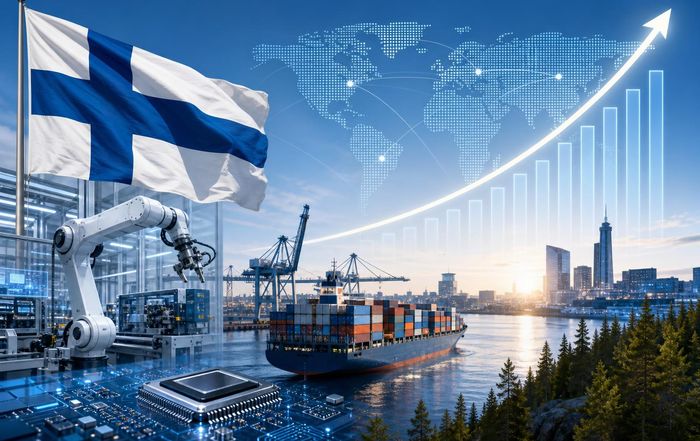
Finland's Technology Exports and Productivity Growth: A Quiet Powerhouse in the Global Economy
Finland's Transformation into a High-Tech Export Leader
Finland's economic narrative over the past three decades is one of deliberate transformation, from a resource-based and manufacturing-heavy economy into one of the world's most knowledge-intensive, innovation-driven societies. For readers of FinancialDailys, this evolution offers a compelling case study in how a small, open economy can leverage technology exports, human capital and digital infrastructure to sustain productivity growth and resilience in an increasingly volatile global landscape.
Finland's export base has long included forest products, machinery and metals, but the country's global image was decisively shaped by the rise of Nokia in the 1990s and early 2000s. While Nokia's dominance in mobile handsets has since faded, the broader technology ecosystem it helped catalyze has matured and diversified, extending into 5G and 6G networks, industrial digitalization, software, gaming, clean technologies and advanced manufacturing. According to the Bank of Finland and Statistics Finland, information and communication technology (ICT) manufacturing and services now account for a disproportionately large share of value added, exports and private R&D spending relative to the size of the economy, underlining the central role of technology in Finland's growth model.
This export and innovation intensity has made Finland a bellwether for investors, policymakers and corporate leaders seeking to understand how digitalization, education and institutional stability can translate into sustained productivity growth. For FinancialDailys readers monitoring global markets and macroeconomic trends, Finland's trajectory provides both empirical lessons and forward-looking signals about the future of advanced industrial economies.
The Structure of Finland's Technology Export Engine
Finland's technology exports are far more diversified today than in the era when mobile phones dominated the country's trade statistics. The most visible pillar remains the ICT sector. Nokia has reinvented itself as a major supplier of network equipment, particularly in 4G and 5G infrastructure, competing with Ericsson and Huawei in Europe, North America and Asia. Public filings and industry data from sources such as Nokia's investor relations pages and the European Commission's digital economy reports show that network equipment, software and related services form a significant share of Finland's high-tech exports, especially to the United States, European Union partners and key Asian markets.
Beyond telecommunications, Finland has become a quiet leader in industrial digitalization and automation. Companies such as Kone, a global player in elevators and escalators, and Wärtsilä, which specializes in marine and energy solutions, embed sophisticated software, sensors and analytics into physical products, enabling predictive maintenance, energy efficiency and remote operations. These firms export not just equipment but also digital services, data-driven performance contracts and long-term maintenance agreements, reflecting a broader shift from product-centric to solution-centric business models that is reshaping global business and trade patterns.
Finland's gaming and software industries represent another high-value segment of its technology exports. Studios such as Supercell and Rovio Entertainment have built globally recognized titles, contributing substantial export revenues through digital distribution platforms. While individual company performance can fluctuate, the broader ecosystem of game developers, middleware providers and creative technology startups has established Finland as a leading European hub for interactive digital content, supported by initiatives like Business Finland's innovation and export promotion programs.
In parallel, Finland is advancing rapidly in clean technologies and energy-related solutions. Finnish firms are active in areas such as smart grids, battery materials, circular economy innovations and bio-based products derived from sustainably managed forests. Reports from Sitra, the Finnish Innovation Fund, and the International Energy Agency highlight Finland's role in piloting low-carbon industrial processes, waste-to-energy solutions and resource-efficient manufacturing techniques that are increasingly in demand as governments and corporations worldwide pursue decarbonization strategies.
These export capabilities are underpinned by an exceptionally strong digital infrastructure and human capital base. Comparative indicators from the OECD and the World Economic Forum consistently rank Finland among the top countries for ICT adoption, digital skills, research collaboration and innovation capacity. The density of high-speed broadband, the early rollout of 5G networks and the integration of digital tools into both public services and private enterprise all contribute to a fertile environment for technology-intensive exports and productivity-enhancing innovation.
Productivity Growth: From ICT Manufacturing to Economy-Wide Diffusion
Finland's productivity performance has been closely linked to its technology sector. During the late 1990s and early 2000s, studies by the Bank of Finland, the OECD and academic researchers found that ICT manufacturing, led by Nokia and its suppliers, accounted for a large share of Finland's labor productivity growth. These gains were driven by rapid technological progress, scale economies and strong export demand, which allowed Finnish firms to invest heavily in R&D and capital deepening.
Following the global financial crisis and the subsequent decline of Nokia's handset business, Finland experienced a period of subdued productivity growth. However, more recent analyses, including work by the European Central Bank and the Finnish Economic Policy Council, indicate that productivity gains have gradually re-emerged, increasingly driven by ICT services, software, data-intensive business models and the digitalization of traditional industries rather than by a single flagship manufacturer. This shift from sector-specific to economy-wide digital diffusion is crucial for long-term growth prospects.
Digital technologies have enabled Finnish companies in manufacturing, logistics, healthcare and energy to optimize processes, reduce waste and enhance product quality. For example, industrial firms are deploying advanced analytics and machine learning to monitor equipment, forecast demand and fine-tune production schedules, while service providers are using automation and self-service platforms to increase efficiency and improve customer experience. Independent evaluations by organizations such as McKinsey Global Institute and the European Investment Bank have highlighted Finland's relatively high rates of digital adoption among both large enterprises and small and medium-sized enterprises (SMEs) compared with many other EU member states.
At the macroeconomic level, Finland's productivity growth has not fully returned to the exceptional rates seen during the peak of the Nokia era, and there is active debate among economists about the extent to which digitalization can offset demographic headwinds and slower global trade growth. Some studies suggest that measurement challenges may understate the real productivity contributions of digital services and intangible capital, while others caution that technological benefits are unevenly distributed across firms and sectors. For readers of FinancialDailys tracking economic fundamentals, this uncertainty underscores the importance of examining micro-level innovation and firm dynamics rather than relying solely on aggregate statistics.
Nevertheless, there is broad consensus across multiple reputable sources, including the OECD, the European Commission and the Bank of Finland, that Finland's sustained investments in education, R&D and digital infrastructure have laid a solid foundation for continued productivity improvements, particularly as artificial intelligence, automation and data-driven services become more deeply embedded in business models.
Education, R&D and Institutions: The Foundations of Competitiveness
Finland's technology export success and productivity performance cannot be understood without examining the institutional and human capital framework that underpins them. The country's education system, frequently cited in comparative assessments such as the OECD's PISA studies, emphasizes equity, teacher quality and problem-solving skills, producing a workforce with strong foundational competencies in literacy, numeracy and critical thinking. This broad base of human capital has enabled rapid adoption of new technologies across sectors, rather than confining digital expertise to a narrow elite.
Higher education and research institutions, including Aalto University, the University of Helsinki and Tampere University, maintain close ties with industry, supporting joint research projects, startup incubation and talent pipelines for technology companies. Finland's R&D intensity, measured as a share of GDP, has historically been among the highest in the world, though it fluctuated after the global financial crisis. Recent policy initiatives, documented by the Finnish Government and independent think tanks, aim to raise R&D spending again through public-private partnerships and targeted incentives, reflecting a strategic commitment to innovation-led growth.
The country's innovation ecosystem is further supported by organizations such as Business Finland, which provides funding, advisory services and internationalization support to startups and established firms. Finland's startup scene, concentrated in hubs like Helsinki and Espoo, has gained international visibility through events such as the Slush conference, which attracts investors, entrepreneurs and corporate leaders from around the world. This environment has produced a stream of high-growth technology companies in fields ranging from fintech and healthtech to industrial software and climate solutions, contributing to both export diversification and productivity gains. Readers interested in emerging companies and funding dynamics can explore more on startups and venture activity covered by FinancialDailys.
Institutional quality also plays a significant role. Finland consistently ranks highly in global indices of governance, transparency and rule of law, including those compiled by Transparency International and the World Bank. Stable institutions reduce transaction costs, support contract enforcement and foster trust between public and private actors, all of which are essential for long-term investment in high-risk, high-return innovation projects. For international investors evaluating Nordic markets, this institutional reliability is often cited as a key factor in capital allocation decisions.
Integration into Global Markets and Supply Chains
Finland's open, export-oriented economy is deeply integrated into European and global markets. As a member of the European Union and the euro area, Finland benefits from access to the single market, common regulatory frameworks and monetary stability, which facilitate cross-border trade in goods, services and data. Technology exports from Finland are closely intertwined with value chains spanning Germany, Sweden, the United States, China and other major economies, particularly in sectors such as telecommunications, automotive components, machinery and software services.
Trade statistics from sources such as Eurostat and Statistics Finland indicate that the European Union remains Finland's largest export destination, but Asia and North America are increasingly important for high-tech products and digital services. The country's technology firms often operate as specialized nodes in complex global supply chains, providing components, software modules or system integrations that are embedded in larger products and platforms. This specialization allows Finnish companies to command high value-added niches, but it also exposes them to geopolitical risks, trade tensions and shifts in global demand.
Recent years have seen heightened attention to supply chain resilience, cybersecurity and digital sovereignty, particularly in strategic sectors such as telecommunications and critical infrastructure. The European Union's regulatory initiatives, including the EU Cybersecurity Act and digital market rules, have implications for Finnish technology exporters, who must balance compliance with varying regulatory regimes in Europe, North America and Asia. Independent analyses from organizations such as the European Council on Foreign Relations and the Bruegel think tank emphasize that Nordic and Baltic countries, including Finland, are at the forefront of navigating this evolving regulatory and geopolitical landscape.
For readers of FinancialDailys focused on international trade and policy, Finland's experience underscores the importance of diversification, strategic partnerships and proactive engagement with multilateral institutions in sustaining technology exports under conditions of global uncertainty.
Sustainability, Green Technology and the Next Wave of Exports
One of the most distinctive features of Finland's technology and productivity story is the centrality of sustainability. The country has set ambitious climate and environmental targets, and these goals are increasingly shaping industrial policy, innovation priorities and export strategies. Finland aims to achieve carbon neutrality within the coming decades, and both public and private actors are investing heavily in low-carbon technologies, circular economy solutions and nature-based innovations.
Finnish companies are active in developing advanced battery materials, particularly in connection with Europe's emerging electric vehicle value chain. Reports from the European Battery Alliance and the European Commission's energy and climate directorates highlight Finland's role in supplying sustainably sourced raw materials, refining technologies and recycling processes that reduce the environmental footprint of battery production. Similarly, Finnish firms are innovating in bio-based materials derived from wood and forest biomass, offering alternatives to fossil-based plastics and chemicals in packaging, textiles and construction.
The circular economy is another area where Finland has positioned itself as a global frontrunner. Sitra and Finnish ministries have developed national roadmaps and pilot projects that encourage companies to design products for longevity, reuse and recycling, as well as to adopt business models based on sharing, leasing and service provision. These initiatives are not only environmentally motivated but also productivity-enhancing, as they drive resource efficiency, reduce input costs and open new revenue streams. Investors and corporate strategists can learn more about sustainable business practices and their financial implications through FinancialDailys' sustainability coverage.
In energy, Finnish firms are advancing smart grid technologies, demand-response systems and hybrid renewable solutions that integrate wind, solar, bioenergy and storage. The International Renewable Energy Agency and the IEA have documented Finland's progress in integrating variable renewables into its electricity system while maintaining reliability, a capability that is increasingly valuable as other countries accelerate their own energy transitions. These capabilities feed into export opportunities for software, control systems, consulting and engineering services.
From a productivity perspective, the alignment between sustainability and technology innovation is particularly powerful. Energy efficiency, waste reduction and resource optimization directly improve cost structures and competitiveness, while environmental regulations and consumer preferences create demand for new products and services. For a small, highly educated economy like Finland, this intersection provides a fertile ground for high-margin, knowledge-intensive exports that reinforce long-term growth.
Financial Markets, Investment and the Role of Capital
Capital markets and financial institutions play a crucial role in translating Finland's technological capabilities into scalable export businesses and productivity-enhancing investments. The Helsinki Stock Exchange, now part of Nasdaq Nordic, lists a range of technology and industrial firms whose performance is closely watched by international investors seeking exposure to Nordic innovation and stability. Market data from Nasdaq Nordic and independent equity research providers show that Finnish technology and engineering stocks often command premium valuations based on their global reach, R&D intensity and strong balance sheets.
Institutional investors, including pension funds and insurance companies, are significant players in Finland's financial ecosystem. Their long-term investment horizons and interest in sustainable, high-quality assets align well with the capital needs of technology exporters and infrastructure projects. In parallel, a growing venture capital and private equity community, both domestic and international, is providing equity financing for startups and scale-ups in software, deep tech and climate technology. For readers monitoring stocks and investment opportunities, Finland's listed and private technology firms offer a mix of mature dividend-paying companies and high-growth innovators.
The Finnish banking sector, overseen by the Financial Supervisory Authority and the Bank of Finland, has remained relatively stable, with strong capitalization and prudent risk management compared with some other European banking systems. This stability supports credit availability for SMEs and mid-sized technology firms, although, as in many advanced economies, there is ongoing discussion about how to further improve financing conditions for early-stage and intangible-asset-heavy companies. Readers interested in the broader financial infrastructure and regulatory environment can explore FinancialDailys' coverage of banking and finance for comparative insights.
Internationally, Finland benefits from its reputation as a reliable, transparent and innovation-friendly jurisdiction, which attracts foreign direct investment into technology sectors. Agencies such as Invest in Finland report growing interest from global technology companies establishing R&D centers, data centers and regional headquarters in the country, drawn by digital infrastructure, talent availability and political stability. This inflow of capital and expertise further strengthens Finland's position as a technology export hub and reinforces productivity-enhancing spillovers across the economy.
Challenges, Uncertainties and the Road Ahead
Despite its strengths, Finland faces a set of structural challenges that will shape the future trajectory of its technology exports and productivity growth. Demographic trends, including an aging population and relatively low birth rates, pose long-term pressures on the labor market, public finances and potential growth. Policy discussions, documented by the Finnish Ministry of Finance and independent analysts, emphasize the need to boost labor force participation, attract skilled immigration and continuously upskill the existing workforce to maintain competitiveness in a rapidly evolving technological landscape.
Global economic conditions and geopolitical tensions also introduce uncertainty. Finland's export-oriented technology firms are sensitive to fluctuations in global investment cycles, trade policies and regulatory frameworks. For example, shifts in telecommunications security standards, data localization rules or climate regulations can create both risks and opportunities for Finnish companies, depending on their adaptability and strategic positioning. Institutions such as the IMF and the OECD have highlighted that small open economies like Finland must remain agile, diversify trade relationships and invest in resilience to navigate these external shocks.
There is also an ongoing debate among economists and policymakers about how to ensure that the benefits of technology-driven productivity growth are broadly shared across regions, sectors and income groups. While Finland's social model provides a relatively strong safety net and active labor market policies, digitalization and automation can still create displacement and adjustment challenges for certain occupations and industries. Organizations like the International Labour Organization and the European Commission's employment directorates stress the importance of lifelong learning, reskilling and inclusive innovation policies to mitigate these risks.
Nonetheless, the overall outlook for Finland's technology exports and productivity performance remains cautiously optimistic. The combination of high-quality education, robust digital infrastructure, strong institutions, an increasingly sophisticated innovation ecosystem and a strategic focus on sustainability positions Finland well to capitalize on global trends in AI, green technology, industrial digitalization and data-driven services. For investors, corporate leaders and policymakers following FinancialDailys, Finland offers a real-world example of how a small, advanced economy can build competitive advantage in the knowledge economy while seeking to align growth with social cohesion and environmental responsibility.
Implications for Global Investors and Policymakers
For global investors, Finland's technology sector represents a concentrated but high-quality opportunity set within the broader Nordic and European markets. Exposure can be obtained through listed equities, private equity, venture capital funds and green or sustainability-linked bonds that finance infrastructure and clean technology projects. Evaluating these opportunities requires careful attention to company-specific fundamentals, regulatory developments and macroeconomic trends, all of which are regularly analyzed in FinancialDailys' investing and finance sections.
Policymakers in other countries can draw lessons from Finland's experience in integrating education, R&D, digital infrastructure and institutional quality into a coherent strategy for technology-driven growth. While institutional and cultural contexts differ, the Finnish case illustrates the importance of long-term investment in human capital, support for collaborative innovation ecosystems and a regulatory environment that encourages experimentation while safeguarding trust and stability. It also highlights the value of aligning technology policy with sustainability objectives, turning environmental challenges into drivers of innovation and export competitiveness.
For corporate executives and entrepreneurs, Finland's ecosystem demonstrates how close collaboration between large incumbents, agile startups, universities and public agencies can accelerate digital transformation and open new global markets. The interplay between industrial strengths in machinery and engineering and emerging capabilities in software, AI and clean technology offers a blueprint for other advanced manufacturing economies seeking to move up the value chain.
As the global economy continues to adjust to technological disruption, climate imperatives and shifting geopolitical alignments, Finland's ongoing journey underscores a broader message that resonates strongly with the mission of financialdailys: sustained productivity growth and competitive advantage are increasingly built not on low costs or scale alone, but on knowledge, trust, adaptability and a clear strategic orientation toward the future. Readers following world economic developments, technology trends and consumer and business dynamics will find in Finland's experience a valuable reference point for understanding how advanced economies can navigate the next era of global competition.
