
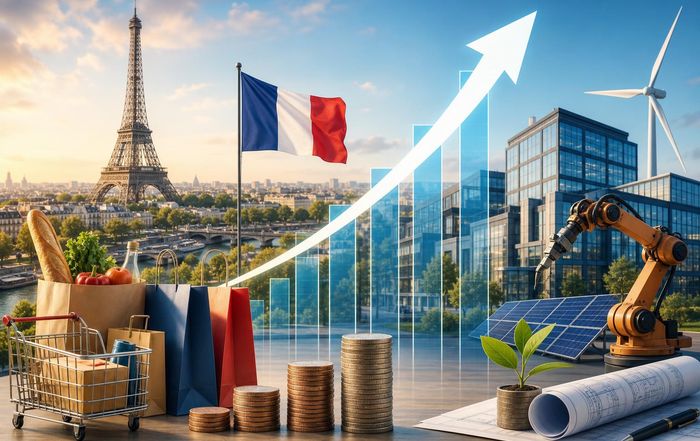
France's Consumer Spending and Business Investment: A Turning Point for a Major European Economy
France's economic trajectory over the past decade has been shaped by powerful and sometimes conflicting forces: demographic stability, deep social protection, persistent structural rigidities, and a wave of reform and innovation that has accelerated since the late 2010s. For readers of FinancialDailys, understanding the interplay between French consumer spending and business investment is essential, not only because France is the euro area's second-largest economy, but also because shifts in its domestic demand and corporate behavior often foreshadow broader European trends.
This article examines how French households are spending, how French firms are investing, and how these dynamics interact with inflation, interest rates, and policy reforms. It also explores what these developments mean for investors, financial institutions, and international businesses that engage with France's markets.
The Role of Consumer Spending in France's Economic Model
Household consumption has long been the backbone of French GDP, consistently representing more than half of total output according to data from INSEE, the national statistics office. Unlike more export-driven European economies such as Germany, France relies heavily on domestic demand, supported by a comprehensive welfare state, regulated labor markets, and relatively stable household incomes.
French households benefit from an extensive social safety net that includes unemployment benefits, universal health coverage, subsidized childcare, and public pensions. Research from the OECD indicates that this social architecture cushions consumption during downturns, reducing the volatility of household spending compared with more market-driven systems. During the pandemic shock, for example, income support schemes and furlough programs limited the drop in disposable income, even as mobility restrictions temporarily depressed consumption of services.
At the same time, this model creates structural pressures. High public spending and taxation-France consistently ranks near the top of the OECD in tax-to-GDP ratios-can weigh on labor incentives and private investment. Policymakers have therefore tried to balance social protection with pro-growth reforms, a tension that continues to shape both consumer behavior and corporate decision-making.
For readers of FinancialDailys, this means that French consumption is typically more resilient in crises, but can also be slower to accelerate in recoveries when confidence is fragile and tax burdens are perceived as high.
Inflation, Real Wages, and the Purchasing Power Debate
The surge in global inflation following the pandemic and the energy price shock hit European households unevenly, and France offers a distinctive case. Thanks to widespread energy price caps, regulated electricity tariffs, and targeted subsidies, French headline inflation remained lower than in many euro area peers at the peak of the crisis. Data from the European Central Bank and Eurostat confirm that France's inflation peak was more muted than that of Germany or the Netherlands.
However, even moderate inflation eroded real purchasing power for many households. While nominal wages did rise, they often lagged behind price increases, especially for lower-income workers in sectors with weaker bargaining power. The debate over "pouvoir d'achat" (purchasing power) became central in French politics, influencing budget priorities, social transfers, and minimum wage adjustments.
Independent analyses by institutions such as the Banque de France and the OECD suggest that real disposable income growth has been uneven across income groups, with social transfers and indexation mechanisms providing some protection at the bottom but leaving middle-income households feeling squeezed. This has had discernible effects on consumption patterns: households have become more selective, prioritizing essential goods, value-for-money retail formats, and experiences that deliver perceived quality, while delaying some discretionary purchases.
For investors following FinancialDailys, these shifts in real income and sentiment help explain the relative outperformance of discount retailers, value-oriented brands, and digital platforms that enable price comparison, while more premium or cyclical segments have faced a more challenging environment.
Changing Patterns in Household Consumption
French consumer spending is not only shaped by income and inflation, but also by structural changes in lifestyle, demographics, and technology. Several trends stand out.
First, the continued rise of e-commerce and digital services has reshaped retail and consumption habits. While France initially lagged some markets such as the United Kingdom in online penetration, recent data from Statista and industry reports show sustained growth in online sales across categories, from fashion and electronics to groceries and home improvement. The pandemic acted as a catalyst, accelerating adoption among older consumers and smaller urban centers.
Second, there is a clear and measurable shift toward more sustainable and locally sourced products. Surveys cited by France Stratégie and consumer research from organizations such as NielsenIQ indicate growing willingness among French consumers-especially younger generations-to pay a modest premium for organic food, low-carbon products, and ethical brands. This has consequences for retail chains, consumer goods companies, and agricultural producers, which are adapting their offerings and supply chains accordingly. Learn more about sustainable business practices through analyses by UNEP.
Third, demographic trends, including population aging and urbanization, are driving demand for health services, long-term care, smaller housing units, and mobility solutions. The strong emphasis on leisure, culture, and travel remains a hallmark of French consumption, benefiting tourism, hospitality, and the creative industries whenever confidence and disposable income allow.
For FinancialDailys readers, these shifts create differentiated sectoral opportunities in consumer-facing equities and private investments, as outlined in our coverage of consumer trends and stocks.
Business Investment: From Structural Weakness to Renewed Dynamism
Historically, France has been perceived as a country with robust public infrastructure and strong large corporations, but with structural weaknesses in private business investment, particularly among small and medium-sized enterprises. Over the last decade, however, there has been a visible change in both the level and composition of corporate investment.
Several factors have contributed to this shift. Corporate tax reform has been central: the gradual reduction of the headline corporate tax rate, combined with enhanced tax credits for research and development, has improved France's attractiveness compared with other large European economies. According to assessments by France's Treasury and independent think tanks such as Institut Montaigne, these measures have supported higher levels of capital expenditure, particularly in manufacturing, technology, and services.
Foreign direct investment has also played a prominent role. Annual surveys by EY consistently rank France among the leading European destinations for FDI projects, especially in industrial and R&D activities. The government's "Choose France" initiative and high-profile investment summits have highlighted commitments by global companies in sectors such as pharmaceuticals, automotive, batteries, cloud computing, and data centers. While exact figures vary by source and methodology, multiple independent reports concur that France has become more competitive in attracting new facilities and expansions.
At the same time, domestic firms have increased their investment in intangible assets, including software, data, and organizational capital. The rise of the French tech ecosystem-often referred to as "La French Tech"-has been supported by public funding tools, venture capital growth, and a more favorable regulatory environment for startups and scale-ups. Readers can explore more detailed coverage in our dedicated startups and tech sections.
The Digital and Green Transformation of French Business
The twin transitions-digital and environmental-are reshaping business investment priorities across France. Companies are allocating capital not only to expand capacity, but to transform how they operate, produce, and deliver services.
On the digital front, the expansion of cloud computing, artificial intelligence, cybersecurity, and data analytics has driven sustained investment in IT infrastructure and skills. Major global cloud providers and domestic champions have announced new data centers, partnerships, and innovation hubs in the country. Reports from BPIFrance, the public investment bank, and analyses by McKinsey & Company highlight that digital adoption has accelerated significantly among French SMEs, although gaps remain compared with leading digital economies.
The environmental transition is equally significant. France's commitment to decarbonization, underpinned by national and EU-level climate targets, has led to major investment programs in renewable energy, electric mobility, energy-efficient buildings, and green industrial processes. The French Ministry for the Ecological Transition and the European Commission document substantial public and private funding for hydrogen projects, battery gigafactories, rail and public transport, and building renovation schemes.
This transformation is reshaping sectors such as automotive and aerospace, where firms are retooling for electric vehicles and low-carbon aviation technologies. It also creates new opportunities in sustainable finance and green bonds, as investors seek to align portfolios with environmental objectives. For deeper perspectives on how sustainability intersects with finance and corporate strategy, readers can refer to sustainability and finance coverage at FinancialDailys.
Financing Conditions, Banking, and Capital Markets
Business investment in France is highly sensitive to financing conditions, particularly given the predominance of bank-based intermediation in continental Europe. The tightening of monetary policy by the European Central Bank in response to inflation has raised borrowing costs for households and firms, influencing both consumption and capital expenditure decisions.
Banks operating in France, including major groups such as BNP Paribas, Crédit Agricole, and Société Générale, have maintained relatively robust capital positions in recent years, according to supervisory data from the European Banking Authority and the Banque de France. Non-performing loan ratios remain contained, though certain sectors exposed to energy prices, commercial real estate, or pandemic-related scarring have required close monitoring.
The corporate bond market and equity markets in Paris, anchored by Euronext Paris, provide alternative funding channels for larger firms and an increasing number of mid-caps. The growth of sustainable finance instruments, including green, social, and sustainability-linked bonds, has been particularly notable, with France among the leading issuers in Europe according to data from the Climate Bonds Initiative.
For readers of FinancialDailys focused on banking and markets, the key takeaway is that while higher interest rates have cooled some investment projects and housing demand, they have also improved net interest margins for banks and increased the attractiveness of fixed-income instruments, creating a more nuanced landscape for allocation decisions.
Housing, Property, and the Wealth Effect
Property markets play an important role in shaping both consumer spending and business investment in France. Residential real estate is a major component of household wealth, and movements in house prices influence confidence, borrowing capacity, and construction activity.
After years of rising prices, particularly in Paris and other major metropolitan areas, the combination of higher mortgage rates and tighter lending standards has begun to moderate the market. Data from Notaires de France and analysis by the Banque de France indicate slower price growth and, in some segments, price declines, alongside reduced transaction volumes. This cooling effect can dampen consumption via negative wealth effects and lower mobility, but it can also improve affordability for first-time buyers over the medium term.
For commercial real estate, structural shifts such as remote and hybrid work, e-commerce, and energy efficiency requirements are transforming demand for offices, retail space, and logistics assets. Investors are reassessing risk-return profiles across segments, with logistics and prime sustainable offices generally faring better than older, energy-inefficient buildings. Those interested in more granular analysis of these dynamics can consult property insights on FinancialDailys and sectoral research from organizations such as Savills and JLL.
Labor Market, Skills, and the Investment Climate
The health of consumer spending and the appetite for business investment both depend heavily on labor market performance. Over the past several years, France has experienced a gradual decline in unemployment compared with the double-digit levels that characterized earlier decades, although the rate remains higher than in some northern European economies. Data from Eurostat and INSEE show improvements in employment among younger cohorts and increased female labor force participation, supported by reforms in vocational training, apprenticeship schemes, and labor market regulations.
Nevertheless, structural challenges persist, including skills mismatches in high-tech and green sectors, regional disparities, and integration barriers for certain demographic groups. Addressing these issues is critical for sustaining productivity growth and ensuring that business investment translates into higher potential output rather than bottlenecks.
From the perspective of multinational firms and investors, labor market reforms, education policy, and immigration rules influence location decisions for new projects and headquarters. Organizations such as the World Economic Forum and the IMF regularly assess France's competitiveness and structural reform progress, providing useful benchmarks for decision-makers.
Readers can explore how these labor dynamics intersect with careers and corporate strategy in the careers section of FinancialDailys, where the focus often turns to skills development, workforce planning, and the future of work.
Policy, Public Finances, and Long-Term Confidence
Public policy remains a decisive factor in shaping both consumer and business behavior in France. Fiscal support during the pandemic and the energy crisis cushioned households and firms but also increased public debt, which already stood at a high level relative to GDP. Institutions such as the Cour des comptes and the European Commission have highlighted the need for credible medium-term consolidation strategies, balancing growth-enhancing investment with expenditure control and tax efficiency.
Tax and labor reforms, investment incentives, and regulatory simplification are closely watched by domestic and international investors. Stability and predictability in these areas support long-term planning and capital allocation, while policy uncertainty can delay investment decisions and weigh on sentiment.
At the same time, France's central role in the European Union means that EU-level initiatives-such as the Recovery and Resilience Facility, industrial policy measures, and the evolving framework for fiscal rules-have direct implications for national investment and spending patterns. Analysts at Bruegel and CEPS, among others, provide in-depth commentary on how these European dynamics affect member states like France.
For FinancialDailys, these policy debates are not abstract: they influence the macro-backdrop for economy coverage, corporate earnings expectations, and the risk-reward calculus for investors considering French assets.
Implications for Investors and Businesses
The evolving landscape of French consumer spending and business investment offers both opportunities and challenges for global investors, corporates, and financial institutions.
On the consumption side, the combination of resilient social protections, targeted fiscal measures, and a strong services culture supports medium-term demand, even if short-term real income pressures occasionally dampen momentum. Sectors aligned with structural trends-digital services, affordable premium experiences, health and wellness, sustainability-oriented products-are better positioned to capture growth than those reliant solely on volume expansion or price increases.
On the investment side, the acceleration of digital and green capital expenditure, supported by public incentives and EU frameworks, creates a multi-year pipeline of projects in infrastructure, manufacturing, technology, and energy. Firms that can navigate France's regulatory environment, build strong local partnerships, and leverage the country's skilled workforce stand to benefit from this transformation.
For portfolio investors, French equities and fixed-income instruments provide exposure to global champions in luxury, aerospace, energy, and financial services, as well as a growing cohort of innovative mid-caps and tech firms. Diversification benefits and the relative stability of the French consumer base add to the appeal, though careful attention to sectoral and policy risks remains essential.
A Strategic Perspective for FinancialDailys Readers
From the vantage point of FinancialDailys, France's story is one of gradual but meaningful change. Consumer spending remains a pillar of the economy, underpinned by a distinctive social model and evolving preferences that increasingly reward digital convenience, sustainability, and quality of life. Business investment, once seen as a relative weakness, has gained momentum through tax reform, improved competitiveness, and a strategic focus on innovation and decarbonization.
The interplay between these forces will shape France's growth path and its role in Europe's economic hierarchy over the coming decade. For decision-makers in finance, investing, banking, and corporate strategy, closely tracking French data, policy signals, and sectoral developments is no longer optional; it is a necessary component of a comprehensive global outlook.
Readers who wish to deepen their understanding of how these trends feed into asset prices, corporate valuations, and cross-border trade flows can explore additional analysis across FinancialDailys, including our dedicated coverage of investing, business, and world developments. In an interconnected global economy, the evolution of France's consumer and investment landscape is not merely a national story; it is a key chapter in the broader narrative of European and international economic transformation.
