
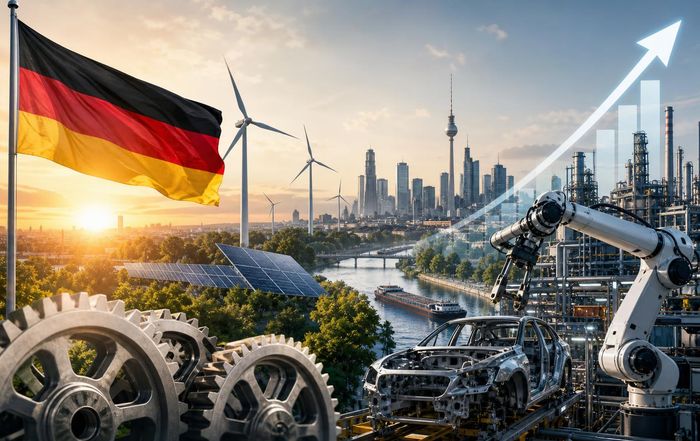
Germany's Industrial Transformation: What It Means for Global Investors
Germany is in the middle of one of the most consequential economic shifts in its post-war history. An economy long defined by heavy industry, autos, chemicals, and precision engineering is being forced to reinvent itself under pressure from deglobalisation, energy shocks, climate policy, demographics, and rapid technological change. For investors, this is not simply a cyclical slowdown story; it is a structural transformation that will reshape where capital flows in and out of Europe's largest economy over the next decade.
This top article examines what is changing in German industry, why it matters for growth and profitability, and how equity, bond, and real-asset investors can position themselves. It focuses on practical implications rather than broad generalities, with an emphasis on sectors, themes, and risk factors.
From "Export Machine" to System Under Strain
For decades, Germany's model combined export-driven manufacturing, relatively cheap and stable energy, and deep integration into global supply chains. The country's current account surpluses regularly exceeded 7% of GDP in the 2010s, and industrial production accounted for a much larger share of output than in most advanced economies.
Several pillars of that model have weakened simultaneously:
The most visible shock came from the energy crisis triggered by Russia's invasion of Ukraine. Before 2022, Germany relied heavily on Russian pipeline gas as a cheap feedstock for its chemicals sector and as a key input for industrial production. When Russian flows were cut, wholesale gas prices in Europe spiked to many times their long-term average. While prices have since fallen back from their peak, they remain structurally higher and more volatile than in the era of abundant Russian supply, and still often above levels in the United States, where industrial users benefit from domestic shale gas. The International Energy Agency (IEA) has documented how this shock hit energy-intensive European industries, with Germany particularly exposed due to its large chemicals and metals sectors.
At the same time, global trade patterns are becoming more fragmented. Rising US-China tensions, sanctions, export controls, and a wider trend towards "friendshoring" and industrial policy have undermined the assumption of ever-deeper globalisation that underpinned Germany's export machine. The World Trade Organization (WTO) has highlighted a slowdown in the growth of global trade volumes and a rise in trade-restrictive measures. German manufacturers with heavy exposure to China and other emerging markets now face both demand uncertainty and political risk.
Domestically, demographics and labour markets are tightening. Germany's working-age population is shrinking, and the OECD projects that without substantial immigration and productivity gains, the labour force will continue to contract. Employers report persistent shortages of skilled workers, from engineers and IT specialists to technicians and care workers. Higher wages are likely over time, but so are bottlenecks and the need for automation.
Finally, regulatory and climate pressures are intensifying. The EU's Green Deal, the Fit-for-55 package, and national climate legislation are pushing German industry towards rapid decarbonisation. The European Commission has introduced instruments such as the Carbon Border Adjustment Mechanism (CBAM), which affects carbon-intensive imports in sectors like steel and cement. While this can protect domestic producers from some forms of carbon leakage, it also raises compliance costs and accelerates the need for low-carbon process innovation.
The combined effect is that Germany's industrial base is under pressure to transform rather than simply recover. For investors, the question is which sectors and companies are leading that transformation, and which may struggle to adapt.
Energy Transition: Threat to Legacy Industry, Tailwind for New Champions
The energy system is at the heart of Germany's industrial transformation. The country's Energiewende (energy transition) aims to phase out fossil fuels and nuclear power while ramping up renewables. That path has been uneven, but it is now being accelerated by both climate policy and the need to reduce dependence on Russian gas.
On the threat side, energy-intensive industries such as chemicals, basic metals, glass, paper, and some parts of machinery face structurally higher input costs and large capex requirements to decarbonise. Companies that once benefited from cheap pipeline gas must now compete in a world of higher and more volatile energy prices, while also investing in green technologies such as hydrogen-ready furnaces, electrification of processes, and carbon capture. The European Chemical Industry Council (Cefic) and national industry groups have warned about the risk of "deindustrialisation" if policy frameworks and energy infrastructure do not keep pace, with some firms already shifting marginal investment to North America or the Middle East.
On the opportunity side, Germany is building out substantial capacity in renewables, grids, and storage. The country remains one of Europe's largest markets for wind and solar, and the Federal Ministry for Economic Affairs and Climate Action (BMWK) has set ambitious targets for renewable shares in electricity consumption. Grid expansion, digitalisation of the power system, and flexible demand management are all needed to integrate intermittent renewables at scale. This creates an investment runway for grid equipment manufacturers, power electronics, software providers, and engineering firms.
Hydrogen is another focal point. Germany has adopted a National Hydrogen Strategy, updated in 2023, aiming to build domestic electrolyser capacity and secure imports of green hydrogen from abroad. While the economics of green hydrogen remain challenging, pilot projects in steelmaking, chemicals, and heavy transport are expanding. Investors should treat hydrogen as a high-risk, high-uncertainty theme: some projects may not reach commercial viability, but successful technologies and infrastructure platforms could become future profit centres, particularly if supported by EU and national subsidies.
For investors looking at sector-level exposure, this transformation intersects with global energy, utilities, and industrials themes. Those interested in broader sectoral dynamics may find the dedicated energy and commodities coverage and economy analysis helpful when assessing how German developments feed into global markets.
Automotive and Mobility: The Electric Challenge
Nowhere is the transformation more visible than in the automotive sector, a cornerstone of German industry and exports. German automakers are grappling with the shift to electric vehicles (EVs), digitalisation of cars, and new competition from US and Chinese players.
German brands remain strong globally, but they are late relative to some peers in fully electric platforms. Tesla and emerging Chinese manufacturers such as BYD and NIO have pushed aggressively into EVs, often with vertically integrated supply chains and strong software capabilities. The European Automobile Manufacturers' Association (ACEA) has documented rapid growth in EV sales across Europe, but also highlights concerns about import competition and the need for charging infrastructure.
In response, German carmakers are investing heavily in:
Dedicated EV platforms and battery-electric models.
Battery cell production, often via joint ventures.
Software-defined vehicle architectures and over-the-air update capabilities.
Partnerships for charging networks and energy services.
The EU has launched an anti-subsidy investigation into Chinese EV imports, reflecting fears of market distortion and strategic dependence. Any resulting tariffs or measures will affect both German manufacturers with production in China and Chinese brands exporting to Europe, adding another layer of policy risk for investors.
From an investment perspective, the key differentiators among auto and component companies are likely to be:
Speed and quality of EV transition: Whether firms can scale profitable EV production, not just launch models.
Software and data capabilities: Control over in-car operating systems and user interfaces, and the ability to monetize connected services.
Battery and supply chain resilience: Access to critical materials and secure, cost-effective cell supply.
Geographic exposure: Balance between China, North America, and Europe, given diverging policy regimes.
Investors following global stocks and sector rotations may want to track how German automakers' valuations reflect these strategic challenges relative to US and Asian peers, which ties into broader equity market coverage and investing analysis.
Digitalisation, Automation, and the Mittelstand
Beyond headline sectors like autos and chemicals, the backbone of German industry is the Mittelstand: thousands of small and mid-sized, often family-owned firms that specialise in niche machinery, components, and industrial services. Many are world leaders in their sub-sectors, but they face two structural challenges: digitalisation and succession.
On digitalisation, Germany has lagged some peers in adopting cloud computing, advanced analytics, and fully integrated digital supply chains. The European Commission's Digital Economy and Society Index (DESI) has repeatedly shown Germany in the middle of the EU pack on measures such as digital public services and business digitalisation. For industrial firms, the crucial shift is towards Industry 4.0: connected machines, predictive maintenance, digital twins, and data-driven optimisation of production.
This is both a risk and a major investment theme. Providers of industrial software, automation equipment, sensors, and robotics stand to benefit as German factories modernise. Global players in factory automation and control systems, as well as specialised German engineering firms, are positioned to capture this capex cycle. At the same time, some smaller firms may struggle to finance and implement complex digital transformations, especially if they face succession issues as founders retire.
Labour shortages are accelerating the push towards automation and robotics. Germany already has one of the highest densities of industrial robots per worker, according to the International Federation of Robotics (IFR), but there is still significant room for further automation in sectors such as logistics, food processing, and construction. For investors, this supports a long-term case for exposure to automation providers and related technology companies both within Germany and globally.
This transformation in production methods intersects with broader themes in technology and innovation, which are covered in more depth in dedicated tech and digital economy analysis and business coverage.
Policy, Subsidies, and the New Industrial Strategy
Germany's industrial transformation is not purely market-driven; it is being shaped by a wave of industrial policy at both the national and EU levels. The policy environment has become more interventionist, mirroring trends in the United States and parts of Asia.
At the EU level, initiatives include the Green Deal Industrial Plan, the Net-Zero Industry Act, and the Chips Act, all designed to foster domestic capacity in strategic sectors such as clean technologies, semiconductors, and advanced manufacturing. The European Commission has relaxed some state aid rules to allow more targeted subsidies, particularly in response to the US Inflation Reduction Act (IRA), which offers generous incentives for clean energy and manufacturing in North America.
Germany is using these frameworks to support investments in battery plants, hydrogen projects, and semiconductor fabs. For example, major chip manufacturers have announced large-scale projects in Germany, often contingent on substantial public support. The Federal Ministry for Economic Affairs and Climate Action regularly publishes updates on approved projects under Important Projects of Common European Interest (IPCEI) schemes, especially in batteries and hydrogen.
For investors, this raises several considerations:
Subsidy-backed projects can offer downside protection but may face political scrutiny and changing rules over time.
Regulatory risk is rising, especially in areas like carbon pricing, environmental standards, and data governance.
Cross-border policy competition means that German projects must be evaluated relative to alternative locations (e.g., US, Eastern Europe, East Asia) that may offer different mixes of cost, incentives, and regulatory risk.
Understanding the evolving policy landscape is critical not only for direct investments in German companies but also for global portfolio allocation across regions and sectors. Readers following trade and policy developments can find additional context in trade and industrial policy coverage and broader world economy analysis.
Real Assets: Infrastructure, Property, and Energy Systems
Germany's transformation also has implications for real assets: infrastructure, property, and energy systems that underpin industrial activity.
Infrastructure investment needs are substantial. The German Council of Economic Experts and international bodies such as the IMF and OECD have long highlighted underinvestment in transport networks, digital infrastructure, and public capital. The energy transition adds further requirements for power grids, storage, and cross-border interconnectors. For long-term investors, this points to a pipeline of potential opportunities in regulated utilities, grid operators, and public-private partnerships, though returns are often shaped heavily by regulation.
The commercial property market is another area to watch. Office and industrial real estate in key hubs such as Munich, Frankfurt, and Hamburg is being reshaped by hybrid work patterns, demand for high-quality logistics space, and the need for energy-efficient buildings. Stricter building codes and rising energy prices are increasing the value of well-located, energy-efficient assets while putting pressure on older stock. Industrial property close to major logistics corridors and ports may benefit from supply chain reconfiguration and nearshoring. Investors focused on real estate and infrastructure can connect these trends to broader property market coverage and banking and credit developments.
At the same time, higher interest rates over the past two years have tightened financing conditions for property developers and leveraged investors. The European Central Bank (ECB) has warned about vulnerabilities in some segments of commercial real estate across the euro area. For Germany, where many investors historically relied on low rates and stable cash flows, this is a regime shift that requires more conservative assumptions on leverage and valuation.
Equity and Sector Positioning: Where Might Capital Flow?
Translating Germany's industrial transformation into portfolio decisions involves balancing structural themes with valuation and cyclical factors. Several broad patterns stand out:
First, investors may increasingly differentiate between legacy high-emissions industries and transition leaders. Within chemicals, metals, and heavy manufacturing, companies that articulate credible decarbonisation pathways, secure low-carbon energy sources, and invest in process innovation are more likely to attract capital. Those that delay may face higher financing costs, regulatory risks, and, over time, shrinking market access in jurisdictions with strict carbon rules.
Second, clean energy, grid infrastructure, and industrial automation look like long-duration growth themes, albeit with policy and execution risk. German and European firms in these areas can benefit from domestic demand plus export markets as other countries modernise their industries. Investors should scrutinise balance sheets, order backlogs, and exposure to cyclical capex cycles, but the structural drivers are robust.
Third, the automotive value chain is undergoing a re-rating. Traditional internal combustion engine (ICE) components face secular decline, while EV-related parts, software, and battery supply chains offer growth but also intense competition and capital intensity. Selectivity is key: not all EV-exposed companies will be winners, particularly if they lack scale or differentiation.
Fourth, small and mid-cap industrials-especially among the Mittelstand-may offer idiosyncratic opportunities. Some are niche global leaders with strong pricing power and healthy balance sheets; others may struggle with digitalisation and succession. Active investors with the capacity for detailed company analysis may find mispricings in this segment, particularly in periods of macro pessimism about Germany as a whole.
Finally, investors must consider currency and macro risk. The euro's value against other major currencies, especially the US dollar, will influence returns for foreign investors. Germany's fiscal stance, ECB policy, and euro area growth prospects remain important macro variables. Readers tracking these themes may find additional insight in broader finance and macroeconomic coverage and global economy analysis.
Fixed Income, Credit, and Banking Implications
Germany's transformation also affects bond and credit markets. On the sovereign side, debates over fiscal rules, investment needs, and constitutional debt limits shape the supply of Bunds and the broader euro risk-free curve. The ECB's monetary policy stance influences yields and spreads not only for sovereigns but also for corporate issuers.
For corporate credit, several factors are in play:
Capex and leverage: Companies investing heavily in decarbonisation, digitalisation, or capacity expansion may raise leverage, affecting credit metrics.
Stranded asset risk: Assets tied to high-carbon processes or outdated technologies may face write-downs over time.
Bank exposure: German banks' loan books are exposed to industrial borrowers and commercial real estate. The ECB and national supervisors have been increasingly vocal about climate-related credit risks and the need for stress testing.
At the same time, high-quality German industrials with strong balance sheets may remain attractive issuers in euro credit markets, offering investors exposure to the transformation with potentially lower volatility than equities. The interplay between bank lending conditions, bond market access, and corporate investment plans is a key area to monitor for those following banking sector developments and fixed-income markets.
Risk Factors and Scenarios Investors Should Watch
Germany's industrial transformation is not guaranteed to succeed smoothly. Several risk factors could alter the trajectory and investment implications:
One major risk is policy inconsistency or delay. If energy infrastructure, permitting processes, and regulatory frameworks do not keep up with the needs of industry, investment may shift abroad. The OECD and business groups have criticised bureaucratic hurdles and slow planning procedures as obstacles to investment.
Another risk is geopolitical fragmentation. Escalating trade conflicts, sanctions, or security crises could disrupt export markets, energy supplies, or supply chains. Germany's deep integration into global trade makes it vulnerable to shocks in regions such as China, Eastern Europe, and the Middle East.
A third risk is social and political backlash. The costs of the energy transition, industrial restructuring, and demographic change could fuel domestic political tensions. Shifts in voter preferences and coalition politics may affect the stability of policy commitments, especially around climate goals and fiscal priorities.
On the upside, positive surprises in innovation and productivity could significantly improve Germany's outlook. Breakthroughs in industrial process efficiency, successful scaling of green hydrogen or carbon capture, and effective digitalisation of the Mittelstand would all support higher growth and corporate profitability than currently expected.
Investors should therefore approach Germany not as a monolithic risk but as a range of scenarios: from a slow, contested transition with pockets of deindustrialisation, to a successful retooling that leaves the country as a high-tech, low-carbon manufacturing hub. Portfolio construction should reflect that uncertainty, with diversification across sectors, regions, and asset classes.
How Global Investors Can Approach Germany's Industrial Shift
For global investors, Germany's industrial transformation presents a mix of long-term opportunity and near-term complexity. The country's manufacturing base, engineering expertise, and institutional framework remain significant strengths, but the old model of cheap fossil energy and frictionless globalisation is gone.
Equity investors may focus on identifying transition leaders in autos, machinery, energy technology, and industrial software, while being cautious about firms heavily exposed to legacy high-carbon assets without clear adaptation plans. Credit investors can look for issuers with robust balance sheets and credible transition strategies, but should actively monitor sectors with high stranded-asset risk or heavy capex burdens. Real-asset investors may find opportunities in energy infrastructure, logistics, and high-quality industrial property aligned with new supply chain patterns.
Across all asset classes, careful attention to policy, technology, and geopolitics is essential. Germany's transformation is deeply intertwined with EU climate policy, global trade dynamics, and technological shifts in energy and manufacturing. For investors willing to navigate that complexity, the coming decade could see a new set of German industrial champions emerge-different from those that dominated the past generation, but potentially just as influential in shaping global markets. That is the end of this article, but not the end of the subject. Continue exploring at your own pace and see where the ideas lead.
