
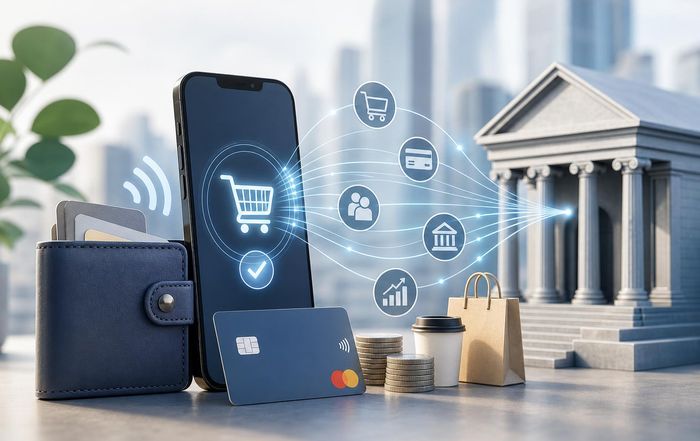
How Consumer Payment Habits Are Reshaping Retail Banking
The way people pay for everyday purchases has changed more in the past decade than in the previous half-century. Contactless cards, digital wallets, buy now, pay later (BNPL), instant bank-to-bank transfers, and embedded finance inside non-bank apps are shifting billions of transactions away from traditional channels. For retail banks, these changes are no longer a side story: they are determining which institutions grow, which stagnate, and which risk being disintermediated from their own customers.
This article explores how evolving consumer payment habits are transforming retail banking economics, technology, competition, and regulation-and what that means for banks, fintechs, and policymakers.
From cash and cards to digital-first payments
Across major markets, consumers are rapidly moving from cash and physical cards to digital and account-to-account payments, though the pace differs by region. Data from the Bank for International Settlements shows a long-term decline in cash usage in most advanced economies, with digital payments growing strongly in both volume and value. In the euro area, for example, the European Central Bank has documented a steady increase in card and mobile payments at the point of sale, even as it stresses the importance of keeping cash available as legal tender.
The COVID-19 pandemic sharply accelerated this transition. The World Bank estimates that the share of adults making or receiving digital payments rose from 35% in 2014 to 57% in 2021 globally, with particularly strong growth in developing economies. In the United States, Federal Reserve research shows contactless and mobile wallet adoption jumping as retailers and consumers sought "touch-free" options, while in markets such as Sweden and Norway, cash has become a niche instrument used by a small minority of consumers.
At the same time, new rails and schemes are emerging. Real-time payment systems such as the SEPA Instant Credit Transfer scheme in Europe, Faster Payments in the UK, FedNow and RTP in the US, and UPI in India are enabling instant account-to-account (A2A) transfers that can substitute for card payments in some use cases. In parallel, wallets from Apple Pay, Google Pay, and Samsung Pay, as well as super-apps and merchant apps, are abstracting away the underlying card or account, making the bank relationship less visible at the point of sale.
For retail banks, this shift is not just about channel preference. It is reshaping interchange revenues, deposit behavior, credit demand, and the very visibility of banks in consumers' financial lives. These trends cut across multiple coverage areas including banking, payments-driven tech, and consumer finance.
The rise of digital wallets and the shrinking visibility of banks
Digital wallets have become a primary interface for payments in many markets, especially on mobile devices. According to McKinsey's Global Payments Report, digital wallet transaction value has grown rapidly worldwide, with wallets now accounting for a large share of e-commerce payments and an increasing share of in-store payments in Asia-Pacific, North America, and parts of Europe. In China, super-apps such as Alipay and WeChat Pay dominate daily payments, while in India, UPI-based apps like PhonePe and Google Pay handle the majority of digital transactions.
From a consumer's perspective, the wallet provider is the brand they see and interact with, even though the underlying funding source is usually a bank card or bank account. This "front-end capture" has two important implications for retail banks. First, it weakens direct brand visibility at the moment of payment, reducing opportunities to differentiate on user experience. Second, it shifts negotiating power and data ownership toward wallet providers and big tech firms, who can aggregate transaction data across multiple banks and merchants.
Banks have responded in several ways. Many have integrated their cards into major wallets as a hygiene factor, while simultaneously investing in their own mobile banking and payment apps to remain relevant. Some are experimenting with white-label or co-branded wallets, particularly in markets where regulators are promoting open banking and interoperability. Others are focusing on value-added services-such as real-time spending insights, subscription management, and merchant offers-embedded in their own apps to keep customers engaged.
However, the economics are challenging. Wallet providers and card networks capture a growing share of the payment "rent," while banks bear much of the regulatory, capital, and fraud-related costs. This is prompting strategic debates about whether banks should double down on payments as a core business, treat them as a utility necessary to support lending and deposits, or seek new partnership and platform models.
Contactless, QR, and the changing point-of-sale experience
Consumer expectations at the checkout have also changed. In many countries, tapping a contactless card or phone has become the default in-store payment method. Visa and Mastercard report that contactless now accounts for the majority of face-to-face card transactions in markets such as the UK, Australia, and parts of Europe, helped by higher transaction limits and widespread terminal upgrades. In parallel, QR-code-based payments have become ubiquitous in Asia and are spreading elsewhere as a low-cost alternative for small merchants.
These habits influence how banks think about card issuance, merchant acquiring, and acceptance infrastructure. On the issuing side, contactless capability is now standard, and digital-only card issuance-provisioning a card directly into a mobile wallet without waiting for plastic-is growing, especially among neobanks and fintechs. On the acquiring side, banks and payment processors are investing in software-based point-of-sale (softPOS) solutions that turn smartphones into terminals, lowering costs for micro-merchants and enabling new business models.
The shift toward QR and A2A payments, particularly in markets like India, Brazil, and Thailand, also affects card economics. Real-time payment systems such as India's UPI and Brazil's Pix, supported by central banks, offer low-cost alternatives to card rails for both consumers and merchants. Banks in these markets are adapting by building user-friendly interfaces on top of instant payment rails and by offering value-added services such as request-to-pay, bill splitting, and loyalty integration to stay competitive.
For global retail banks, the challenge is to manage these diverse payment preferences across regions while maintaining consistent risk controls and customer experience. The shift in point-of-sale behavior is also closely tied to broader market structure changes, as acquirers, gateways, and fintech aggregators compete to own merchant relationships.
Buy now, pay later and the reconfiguration of consumer credit
One of the most visible shifts in consumer payment behavior has been the adoption of buy now, pay later services. Providers such as Klarna, Afterpay, Affirm, and a growing number of bank-backed and merchant-branded schemes allow customers to split purchases into installments, often with no explicit interest charge if payments are made on time. Data from the Bank of England and other regulators shows strong BNPL growth over recent years, particularly among younger consumers and in online retail.
BNPL blurs the line between payments and credit. At checkout, the consumer experiences it as just another way to pay, often with a single click or tap. Behind the scenes, however, providers perform risk assessments, advance funds to merchants, and collect repayments over time. This has several implications for retail banks. Traditional credit card usage may be cannibalized, especially for discretionary online purchases, reducing interest and interchange income. At the same time, banks that do not offer BNPL risk losing relevance with merchants seeking higher conversion rates and with consumers who value flexible payments.
Some banks have launched their own BNPL products, either card-linked (allowing customers to convert past purchases into installments) or integrated directly at merchant checkout. Others have partnered with existing BNPL providers or white-label platforms. Regulators, including the UK's Financial Conduct Authority and the Australian Securities and Investments Commission, are increasingly scrutinizing BNPL for potential consumer harm, over-indebtedness, and transparency issues, which may narrow the advantage BNPL has enjoyed over regulated credit.
This area illustrates how payment habits can reshape the broader consumer credit landscape. The shift toward embedded, transaction-level credit pushes banks to rethink underwriting models, data usage, and product design, as well as how they manage credit risk in an environment where many small exposures are originated at high speed through digital channels.
Real-time payments, open banking, and account-to-account alternatives
Real-time account-to-account (A2A) payments and open banking are enabling new ways to pay that bypass traditional card schemes entirely. In Europe, the Revised Payment Services Directive (PSD2) and the emerging PSD3 and Payment Services Regulation frameworks have mandated access to customer account data and payment initiation for licensed third parties, leading to the growth of open banking providers that can trigger A2A payments directly from a consumer's bank account. The European Commission and European Banking Authority have also proposed making instant credit transfers in euro widely available and affordable.
In the UK, open banking-enabled A2A payments are increasingly used for e-commerce, bill payments, and account top-ups, supported by the Open Banking Implementation Entity standards and the Faster Payments system. In India, UPI demonstrates how a unified, API-based instant payment infrastructure can drive mass adoption of A2A for everyday transactions. Brazil's Pix and Thailand's PromptPay show similar dynamics, often with strong central bank sponsorship.
For retail banks, this trend cuts both ways. On one hand, A2A payments can be cheaper to process than cards, reduce chargeback risks, and support new propositions such as real-time disbursements, salary advances, or gig-worker payouts. On the other hand, open banking allows third-party providers-fintechs, big techs, and merchants-to initiate payments from bank accounts without the bank controlling the front-end experience. This can accelerate the commoditization of payment processing and make it harder for banks to differentiate.
Banks that embrace open APIs and real-time capabilities can position themselves as core infrastructure providers and partners in the emerging embedded finance ecosystem. Those that lag risk being relegated to back-office utilities while others capture the customer relationship and the data-driven value-added services built on top.
Embedded finance and the erosion of traditional banking boundaries
As payment habits become more digital and contextual, financial services are increasingly embedded into non-bank platforms. Consumers now encounter payment and credit options inside ride-hailing apps, online marketplaces, social media platforms, and even video games. Merchants can integrate financing, insurance, and loyalty seamlessly into the checkout flow, often powered by banking-as-a-service (BaaS) providers and licensed banks operating behind the scenes.
This embedded finance trend is reshaping retail banking distribution. Instead of customers going to a bank to initiate a payment or apply for a card, the bank's products are distributed through digital ecosystems where the primary customer relationship belongs to the platform. Research from Accenture and others suggests that a significant portion of future banking revenue growth could come from embedded models, particularly in payments and lending.
For banks, this creates both opportunity and risk. Partnering with platforms and fintechs can generate new transaction volumes and fee income, especially in startups and digital businesses that prefer API-based solutions. However, it can also compress margins and increase operational and compliance complexity, as banks must oversee third-party activities under increasingly strict outsourcing and operational resilience rules.
Strategically, banks must decide where to compete and where to collaborate. Some aim to become "orchestrators" of ecosystems, building their own marketplaces and developer platforms. Others focus on being "specialist providers" of regulated capabilities-such as KYC, underwriting, and regulated payment processing-to a wide range of partners. Consumer payment habits, particularly the desire for seamless, integrated experiences, are pushing banks toward one or more of these roles whether they intend to or not.
Economics under pressure: fee income, deposits, and cross-sell
Changing payment behaviors have direct consequences for retail banking economics. Historically, current accounts and payment cards have been gateways into broader relationships, supporting cross-selling of mortgages, personal loans, savings, and investment products. Interchange fees, foreign exchange margins, and account charges have provided a stable stream of non-interest income.
Today, several forces are squeezing these revenue lines. Regulatory caps on interchange in regions such as the EU, competitive pressure from fintechs on foreign exchange fees, and consumer expectations of low- or no-fee digital accounts have reduced the margin available per transaction. At the same time, the shift toward wallets, BNPL, and A2A can fragment payment flows and weaken the link between everyday spending and the primary bank relationship.
Deposit behavior is also changing. Instant transfers and digital account opening make it easier for consumers to move balances between banks and non-bank providers in search of higher yields or better experiences. In higher-rate environments, this can accelerate deposit outflows from traditional current accounts to money-market funds, fintech savings apps, or brokerage accounts. These shifts intersect with broader market and rate dynamics, creating new liquidity management challenges for banks.
To adapt, many institutions are rethinking their product and pricing strategies. Some are bundling payments with subscription-style account packages that include insurance, travel benefits, or premium support. Others are using transaction data to power personalized offers in investing, wealth management, or credit. The central question is whether banks can translate their remaining advantages-regulatory trust, balance sheet strength, and data depth-into differentiated value in a world where the basic act of paying is increasingly commoditized.
Technology and infrastructure: from batch to always-on
Consumer expectations of instant, 24/7 payments are forcing banks to overhaul core technology that was often designed for batch processing and limited operating hours. Implementing real-time payments, instant card issuance, and immediate balance updates requires modern, API-driven architectures and robust fraud-detection systems capable of making decisions in milliseconds.
Many incumbent banks are investing heavily in core-banking modernization, cloud migration, and microservices architectures. Reports from consultancies such as BCG and Deloitte highlight that a significant share of global bank tech budgets is now directed toward payments infrastructure, including ISO 20022 migration, instant payment connectivity, and API gateways. At the same time, regulators like the European Central Bank and national supervisors are tightening expectations around operational resilience, cyber security, and incident reporting, raising the bar for payment system reliability.
Fintech challengers and digital-only banks often benefit from more modern stacks, enabling them to roll out new payment features quickly and at lower marginal cost. This creates competitive pressure on incumbents, but also partnership opportunities: some banks are choosing to leverage fintech platforms as a faster route to market for certain payment propositions, while keeping core ledgers in-house.
The move to always-on payments also has treasury and risk implications. Liquidity must be managed in real time across multiple clearing systems and currencies, and intraday funding needs may become more volatile. Banks are developing new tools for real-time liquidity monitoring and stress testing, often in collaboration with central banks and payment system operators.
Fraud, security, and consumer protection in a faster world
Faster, more convenient payments come with heightened fraud and security risks. Real-time transfers can be irrevocable, giving banks and consumers little time to detect and reverse fraudulent transactions. Social-engineering scams, authorized push payment (APP) fraud, account takeover attacks, and synthetic identities are all rising concerns documented by regulators and industry bodies such as UK Finance and the European Banking Authority.
Consumer payment habits play a role here. The more often people pay via mobile apps, QR codes, or links received through messaging platforms, the more attack surfaces fraudsters can exploit. At the same time, consumers expect frictionless experiences and may resist additional authentication steps, creating tension between security and usability.
Regulators are responding. In the UK, the Payment Systems Regulator is introducing mandatory reimbursement for many APP fraud cases, effectively sharing liability between sending and receiving banks and incentivizing stronger controls. The EU's evolving regulatory framework under PSD2 and forthcoming rules emphasizes strong customer authentication, transaction monitoring, and incident reporting. In the US, agencies including the Consumer Financial Protection Bureau and Federal Trade Commission are scrutinizing digital payment platforms and peer-to-peer apps for consumer protection risks.
Retail banks must invest in advanced analytics, behavioral biometrics, device fingerprinting, and AI-driven anomaly detection to keep pace with sophisticated fraud schemes. They also need clearer communication with customers about risks, responsibilities, and safe behavior. As payment options proliferate, consumer education becomes a critical component of risk management, not just a compliance checkbox.
Inclusion, cash, and the risk of leaving people behind
While digital payments bring efficiency and convenience, they also raise concerns about financial inclusion and resilience. Not all consumers are ready or able to go fully digital. Older people, individuals with disabilities, rural populations with limited connectivity, and those without formal identification or stable income may rely heavily on cash or face barriers to using digital services.
Central banks and policymakers are increasingly vocal about preserving access to cash and ensuring that digital payment innovations do not exclude vulnerable groups. The European Central Bank, the Bank of England, and other authorities have published policy papers on the importance of cash as a public good and a backup in case of digital outages. Some jurisdictions have introduced rules requiring banks to maintain a minimum level of cash access through branches, ATMs, or shared service points.
At the same time, digital payments can be powerful tools for inclusion when designed appropriately. Initiatives such as India's Jan Dhan-Aadhaar-Mobile (JAM) trinity, Brazil's Pix, and mobile-money platforms in parts of Africa have brought millions of previously unbanked people into formal financial systems. For retail banks, this opens new markets but also demands tailored solutions-simplified accounts, low-fee structures, vernacular-language apps, and agent networks-that differ from traditional branch-centric models.
Balancing innovation with inclusion is becoming a strategic and reputational issue for banks. Payment habits are not uniform across society, and institutions that ignore the needs of less digital-savvy segments risk regulatory pushback and loss of trust.
Strategic choices for retail banks in a payments-led future
Taken together, evolving consumer payment habits are forcing retail banks to make a series of interconnected strategic choices. These include how prominently to position payments in their business model, which roles to play in emerging ecosystems, and how to allocate capital between modernizing legacy systems and pursuing new growth opportunities.
Banks that view payments as a strategic differentiator are investing in superior user experience, data-driven personalization, and partnerships with merchants and platforms. They are reimagining their mobile apps as daily financial hubs rather than occasional balance-checking tools, integrating budgeting, subscriptions, loyalty, and even non-financial services. Others are focusing on building scalable, resilient payment infrastructure and monetizing it through BaaS and white-label offerings.
Regulatory and macroeconomic environments will shape these decisions. Interest-rate cycles affect the relative importance of fee income versus net interest margin, while regulatory developments in open banking, instant payments, and consumer protection influence which business models are feasible. In some markets, central bank digital currency (CBDC) pilots and discussions add another potential layer of change, though most CBDC projects remain at exploratory or limited pilot stages according to the BIS and IMF.
For investors and analysts tracking banking, stocks, and global financial markets, understanding how individual institutions are responding to these payment shifts can offer insight into future profitability and competitive positioning. Metrics such as digital wallet penetration among customers, instant payment volumes, BNPL exposure, and the share of transactions initiated via third-party platforms are increasingly relevant indicators alongside traditional loan and deposit figures.
Ultimately, consumer payment habits are not just another trend for retail banks to monitor; they are a primary driver of how value is created and distributed in modern financial services. Institutions that treat payments as a strategic lens-shaping technology, partnerships, risk management, and customer engagement-are more likely to remain central to everyday financial life as the industry's boundaries continue to blur.
