
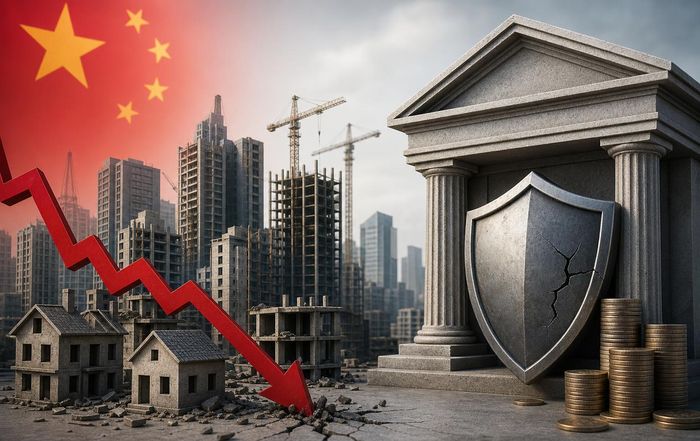
China's Property Crisis: How It Is Reshaping the Country's Banking System
China's once-booming property market has slightly shifted from being a core growth engine to a potential structural risk for the country's financial system. For domestic banks, which spent two decades expanding their balance sheets on the back of real estate lending, the slowdown is testing capital strength, business models, and the credibility of official risk controls in real time. This globally related financial document examines how the downturn in China's property sector developed, what it means for banks' balance sheets and funding, how authorities are responding, and what global investors should watch next.
From Growth Engine to Drag: How Property Became Systemic
Real estate has been central to China's growth model since the early 2000s. Housing, construction, and related supply chains are estimated by many analysts to have accounted for roughly a quarter to nearly a third of GDP at their peak, once upstream and downstream sectors are included. Local governments relied heavily on selling land-use rights to developers, while households poured savings into apartments as their primary store of wealth.
Chinese banks were deeply embedded in this ecosystem. According to the People's Bank of China (PBoC), property-related credit-including mortgages, developer loans, and lending to local government financing vehicles (LGFVs)-has represented a large share of outstanding bank credit. Mortgages alone became one of the safest and fastest-growing product lines for many lenders, supported by high down-payment ratios and rising prices.
The turning point came as authorities sought to rein in leverage and speculative excess. In 2020, regulators introduced the so-called "three red lines" policy, setting thresholds on developers' debt-to-asset, net gearing, and cash-to-short-term-debt ratios. Developers that breached all three faced strict limits on additional borrowing. This move coincided with tighter rules on banks' property loan exposures, designed by the PBoC and the China Banking and Insurance Regulatory Commission (CBIRC, now merged into the National Financial Regulatory Administration, NFRA).
The combination of regulatory tightening, slowing demand, and demographic headwinds exposed the fragility of highly leveraged developers. Defaults by large firms such as China Evergrande Group and Country Garden signaled that the boom phase had ended and that systemic risks were migrating onto banks' balance sheets.
For readers following broader macro developments, this shift in China's growth model sits squarely at the intersection of economy, property, and banking coverage worldwide.
The Scale of the Property Slowdown
The severity of the downturn is evident in multiple indicators. Official data from the National Bureau of Statistics (NBS) show that new home sales by floor area have fallen sharply from their peak, with multi-year declines in many major cities. Investment in real estate development has contracted, and the stock of unsold housing has risen, especially in smaller "lower-tier" cities.
Price data tell a similarly challenging story. NBS's 70-city index has shown broad-based weakness, with more cities reporting month-on-month price declines than increases for extended periods. Independent analysis from organizations such as the Bank for International Settlements (BIS) and research houses indicates that real (inflation-adjusted) housing prices in some regions have fallen significantly from peak levels.
Demographics and sentiment compound the cyclical downturn. China's population is now shrinking and urbanization is slowing, reducing the structural tailwind for new housing demand. Households, already heavily exposed to property as a wealth store, are more cautious about taking on new mortgages amid job-market uncertainty and falling prices.
These trends matter for banks because they affect both sides of their property exposure: the credit quality of loans to developers and homebuyers, and the collateral values underpinning those loans. A sustained correction, rather than a short cyclical dip, implies a more prolonged drag on earnings and capital.
Where Banks Are Exposed: Developers, Households, and Local Governments
Chinese banks' property exposure is multifaceted. Understanding the channels is key to assessing systemic risk.
First, there are direct loans to developers. Large state-owned commercial banks, joint-stock banks, and city commercial banks all extended credit to real estate firms, though the concentration varies. When developers default or delay projects, banks face rising non-performing loans (NPLs), restructuring pressures, and potential write-downs. The fallout from Evergrande's default-which culminated in liquidation orders in Hong Kong-highlighted how quickly a developer's distress can ripple through creditors, suppliers, and homebuyers.
Second, there are residential mortgages, historically considered among the safest assets on banks' books due to high required down payments and recourse lending. However, the recent wave of "mortgage boycotts", in which homebuyers threatened to stop paying on loans for unfinished projects, underscored a new risk: performance of the underlying asset (delivery of the apartment) is now a factor in credit behavior. While authorities moved quickly to contain the boycotts, they revealed that mortgage portfolios are not entirely insulated from construction risk.
Third, banks have significant indirect exposure via local governments and LGFVs. Local authorities relied on land sales to developers as a major revenue source; as land sales plunged, fiscal strains have increased. Many LGFVs, which borrow to fund infrastructure and urban development, used land as collateral or depended on buoyant property markets to justify projects. If land values and related revenues fall, LGFVs' ability to service debt weakens, raising credit-risk concerns for banks that lent heavily into this segment.
Beyond credit exposures, property-related activities also contributed meaningfully to banks' fee and commission income, including from wealth management products linked to real estate, project financing, and ancillary services. As the sector slows, these non-interest revenue streams come under pressure, affecting profitability even when headline NPL ratios appear contained.
For readers tracking broader finance and markets developments, the property-banking nexus is one of the most important structural themes in China's economic transition.
Rising Credit Risk and the Question of Hidden Losses
Officially reported NPL ratios at major Chinese banks remain relatively low, typically in the low single digits. However, analysts, multilateral institutions, and rating agencies have consistently warned that headline figures may understate true stress, particularly in sectors like property and LGFVs.
One reason is the use of loan restructurings, extensions, and "evergreening" practices, in which banks roll over or extend credit to troubled borrowers rather than classifying loans as non-performing. While such measures can be justified as part of an orderly workout, they also delay recognition of losses. The IMF and others have highlighted the risk that a significant share of property-related loans are "at risk" even if not yet labeled as NPLs.
Another concern is collateral valuation. When banks underwrite property loans, they rely on appraised land and housing values to determine loan-to-value (LTV) ratios and provisioning needs. In a falling market, collateral may be worth less than assumed, particularly in smaller cities where liquidity is thin and price discovery is poor. If valuations are slow to adjust, banks' capital positions can appear stronger on paper than they would under more conservative assumptions.
Some stress has already surfaced. Several small and regional banks have required capital injections, restructurings, or mergers in recent years, with property and LGFV exposures often cited as contributing factors. While large state-owned lenders benefit from an implicit sovereign backstop and stronger capital buffers, they too have reported rising credit costs and higher provisioning related to real estate and local government loans.
Global investors and counterparties are watching closely because the true scale and distribution of losses will influence perceptions of China's financial stability, sovereign risk, and the outlook for stocks and credit markets.
Funding, Confidence, and the Role of State Support
Thus far, China has avoided a classic banking crisis characterized by bank runs, widespread funding freezes, or a systemic collapse in interbank confidence. Several structural features and policy choices explain this relative stability, even amid deep property stress.
China's banking system is dominated by large state-owned institutions, and authorities maintain extensive control over deposit rates, capital flows, and key funding channels. The PBoC has provided ample liquidity through tools such as reserve requirement ratio (RRR) cuts and medium-term lending facilities, ensuring that banks can access funding even when market sentiment is weak. This policy framework reduces the likelihood of sudden funding shocks seen in more liberalized systems.
At the same time, depositors in China have historically shown strong confidence in state backing for major banks. While isolated episodes of stress at small rural banks have led to localized protests or withdrawal pressures, they have not triggered nationwide contagion. Authorities have intervened quickly with restructurings, takeovers, or guarantees to reinforce trust.
However, this stability comes with trade-offs. The expectation of state support can create moral hazard, encouraging banks and borrowers to take on more risk under the assumption that losses will be socialized. It can also slow the pace of necessary balance-sheet repair, as the urgency to recognize and resolve bad loans is reduced. Over the long term, this may weigh on credit efficiency and the allocation of capital, with implications for productivity and growth.
For international observers, the key question is not whether China faces an acute banking crisis in the near term, but whether prolonged, policy-managed stress in the financial system translates into a "slow burn" drag on economic performance and corporate profitability.
Policy Responses: Targeted Relief and Structural Tightrope
Chinese policymakers are attempting to balance three goals that are difficult to reconcile: stabilizing the housing market and banking system, protecting homebuyers and social stability, and advancing a long-stated objective to reduce leverage and speculative excess in real estate.
On the demand side, authorities have rolled out measures to support homebuying and ease the burden on existing borrowers. These include reductions in benchmark mortgage rates, lower minimum down-payment ratios in many cities, and relaxation of purchase restrictions in some markets. The PBoC has also guided banks to adjust mortgage terms for eligible borrowers to reduce monthly payments.
On the supply and developer side, the government has promoted a "whitelist" approach, encouraging banks to support financing for selected projects deemed important for completion and delivery. Regulators have also allowed more flexibility in how banks classify and provision for certain real estate exposures, aiming to avoid a sudden cliff-edge in reported asset quality. New tools, such as special lending facilities to support unfinished projects, are designed to address the most politically sensitive issue: undelivered homes for millions of buyers.
At the same time, top leadership has repeatedly emphasized that "houses are for living in, not for speculation," signaling that a full return to the old, highly leveraged growth model is unlikely. The IMF and other institutions have argued that a comprehensive policy package will be needed, combining targeted fiscal support, stronger social safety nets, and a clearer framework for dealing with insolvent developers and LGFVs.
For banks, these policies mean a managed transition rather than a clean break. They are expected to support policy goals-by rolling over loans, financing project completion, and absorbing some losses-while maintaining stability. Over time, this could compress profitability and weigh on return on equity, particularly for lenders with heavy exposure to weaker regions or smaller cities.
Diverging Outlooks: Large vs. Small Banks
The impact of the property downturn is not uniform across China's banking system. Large state-owned commercial banks, such as ICBC, China Construction Bank, and Agricultural Bank of China, generally have more diversified loan books, stronger capital ratios, and better access to funding. They are also more directly aligned with government policy objectives and enjoy the strongest implicit guarantees.
Joint-stock commercial banks and city commercial banks, particularly those heavily concentrated in property-dependent regions, may face greater pressure. Many of these institutions expanded aggressively into real estate lending and LGFV financing during the boom years. As local economies slow and land sales slump, their borrowers' repayment capacity weakens, and collateral values may fall faster than at the national level.
Rural commercial banks and smaller institutions are even more vulnerable, given narrower capital buffers, weaker governance, and concentrated geographic exposure. Several have already undergone restructuring or consolidation, with regulators encouraging stronger institutions to absorb weaker ones. The NFRA and PBoC have stepped up risk monitoring and stress testing, underscoring official concern about pockets of fragility.
For investors in Chinese bank equities and bonds, this divergence suggests a more nuanced approach is needed than simply treating "China banks" as a single asset class. Balance-sheet quality, regional exposure, and state support assumptions all matter, and they intersect closely with the evolving property landscape.
Spillovers to Markets, Growth, and Global Investors
The property-banking nexus has implications far beyond domestic credit metrics. For China's broader economy, a prolonged real estate adjustment weighs on construction, household wealth, and local government finances, all of which dampen growth. The World Bank and OECD have repeatedly cited property and associated financial risks as key drags on China's medium-term growth outlook.
Slower growth in China feeds into global trade, commodity demand, and corporate earnings. Exporters of iron ore, copper, and other construction-related materials-from Australia and Brazil to parts of Africa-are sensitive to China's building cycle. Multinational firms in construction equipment, luxury goods, and consumer durables also feel the impact as Chinese households adjust spending in response to weaker property-derived wealth.
Financial markets reflect these linkages. International investors in Chinese equities and bonds, as well as in companies heavily exposed to China, increasingly factor property and banking risks into valuations. Rating agencies have adjusted outlooks for certain developers, local government entities, and in some cases banks, based on evolving assessments of real estate stress and policy support.
For global readers focused on investing and world markets, China's property-banking adjustment is therefore not a local story but a structural theme with cross-border ramifications.
What to Watch Next
Several signposts will help determine how China's property and banking adjustment unfolds:
One is the trajectory of housing sales and prices, particularly in smaller cities where oversupply appears most acute. A stabilization in transaction volumes and a slowing pace of price declines would ease pressure on both developers and banks. Conversely, continued weakness would increase the likelihood of more defaults and restructurings.
Another is the evolution of policy support. Markets are watching whether Beijing moves toward more aggressive fiscal measures, such as larger central government transfers to localities, broader programs to buy or repurpose unsold housing, or more explicit support for bank capital. The balance between targeted relief and systemic bailouts will shape both moral hazard and investor confidence.
Third, transparency around bank asset quality will be critical. Greater disclosure on property and LGFV exposures, clearer classification standards, and credible stress tests-potentially with input from multilateral institutions-could help reduce uncertainty. Conversely, if investors perceive that losses are being persistently hidden, risk premiums for Chinese financial assets are likely to remain elevated.
Finally, the pace at which banks can reorient their business models away from property-heavy growth toward more diversified lending-such as to high-tech industries, green projects, or consumer finance-will influence long-term profitability and systemic resilience. This shift intersects with broader themes in China's economic strategy, including industrial upgrading, digitalization, and sustainability.
China's property sector and its domestic banks are now in a complex, multi-year adjustment rather than a short, cyclical downturn. For policymakers, the challenge is to defuse legacy risks without triggering a crisis or reigniting the same excesses that created them. For banks, it is to absorb losses, support policy goals, and adapt to a new growth model with less reliance on real estate. For global investors, it is to distinguish between cyclical noise and structural change-recognizing that how China manages this transition will help shape not only its own financial system, but also the contours of global markets in the decade ahead.
